> ## Documentation Index
> Fetch the complete documentation index at: https://dragonwingdocs.qualcomm.com/llms.txt
> Use this file to discover all available pages before exploring further.
# I2C
Inter-Integrated Circuit (I²C) is a bidirectional, two-wire serial bus for short-distance communication between integrated circuits, where devices communicate using assigned bus addresses.
## Overview
### Key Characteristics
* Bidirectional 2-wire serial bus (SDA + SCL)
* 7-bit or 10-bit target addressing
* Multi-controller mode support
### Operating Modes
| Mode | Speed |
| --------------- | -------------------------- |
| Standard mode | 100 kbps |
| Fast mode | 400 kbps |
| Fast mode plus | 1 Mbps (maximum supported) |
| High-speed mode | 3.4 MHz (not supported) |
### Communication Sequence
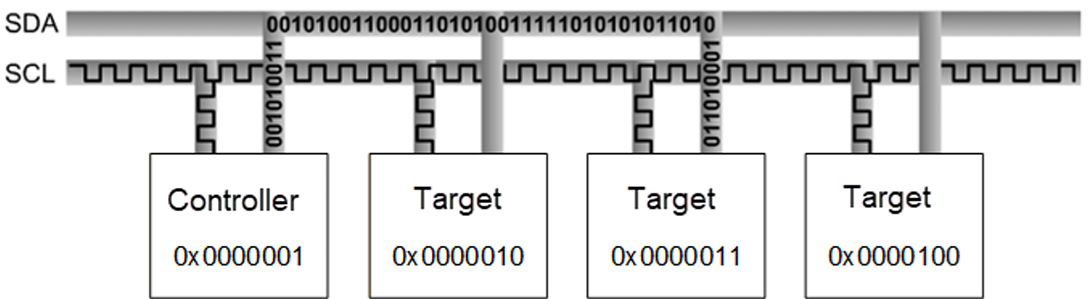
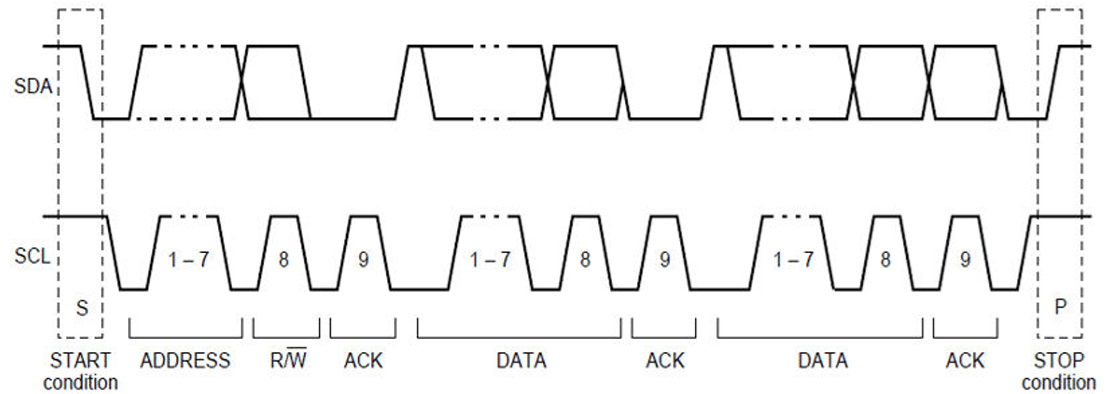 **Packet structure:** Start → Address frame (7/10-bit) → R/W bit → ACK/NACK → Data frames (8-bit) → Stop
**Signal rules:**
* SCL HIGH: SDA must remain stable
* SCL LOW: SDA may change
* Exception: START and STOP sequences may change SDA when SCL is HIGH
### Transfer Modes by Subsystem
| Subsystem | Transfer Mode | Bus Speeds |
| ----------------------------- | ------------------ | -------------------------- |
| **Linux** | FIFO, CPU DMA, GSI | 100 kHz, 400 kHz, 1000 kHz |
| **Boot** | FIFO | 100 kHz, 400 kHz, 1000 kHz |
| **aDSP / Qualcomm TEE / SDC** | FIFO | Standard |
## Interface Components
### Device Tree Sources
| Platform | Device Tree File |
| ------------------ | -------------------------------------- |
| Dragonwing IQ-9075 | `arch/arm64/boot/dts/qcom/lemans.dtsi` |
### APIs
| Subsystem | Header |
| ------------ | ----------------------------------------------------- |
| Linux | `include/linux/i2c.h`, `include/linux/i2c-dev.h` |
| Boot | `boot_images/boot/QcomPkg/Include/i2c_api.h` |
| aDSP | `adsp_proc/core/api/buses/i2c_api.h` |
| Qualcomm TEE | `trustzone_images/core/buses/api/i2c/qupv3/i2c_api.h` |
## Software Device Tree Configuration
### Linux Device Tree Example
```dts theme={null}
i2c21: i2c@b80000 {
compatible = "qcom,geni-i2c";
reg = <0x0 0xb80000 0x0 0x4000>;
#address-cells = <1>;
#size-cells = <0>;
interrupts = ;
clocks = <&gcc GCC_QUPV3_WRAP3_S0_CLK>;
clock-names = "se";
pinctrl-0 = <&qup_i2c21_default>;
pinctrl-names = "default";
interconnects = <&clk_virt MASTER_QUP_CORE_3 QCOM_ICC_TAG_ALWAYS
&clk_virt SLAVE_QUP_CORE_3 QCOM_ICC_TAG_ALWAYS>,
<&gem_noc MASTER_APPSS_PROC QCOM_ICC_TAG_ALWAYS
&config_noc SLAVE_QUP_3 QCOM_ICC_TAG_ALWAYS>,
<&aggre1_noc MASTER_QUP_3 QCOM_ICC_TAG_ALWAYS
&mc_virt SLAVE_EBI1 QCOM_ICC_TAG_ALWAYS>;
interconnect-names = "qup-core", "qup-config", "qup-memory";
power-domains = <&rpmhpd SA8775P_CX>;
dmas = <&gpi_dma3 0 0 QCOM_GPI_I2C>,
<&gpi_dma3 1 0 QCOM_GPI_I2C>;
dma-names = "tx", "rx";
status = "disabled";
};
```
GPIO pinctrl:
```dts theme={null}
qup_i2c21_default: qup-i2c21-state {
pins = "gpio13", "gpio14";
function = "qup3_se0";
};
```
### QUPAC Access Control
Ensure the correct protocol is set in `QUPAC_Access.c`:
```c theme={null}
{ QUPV3_0_SE0, QUPV3_PROTOCOL_I2C, QUPV3_MODE_FIFO, AC_HLOS, TRUE, TRUE, FALSE },
{ QUPV3_1_SE5, QUPV3_PROTOCOL_I2C, QUPV3_MODE_GSI, AC_HLOS, FALSE, TRUE, FALSE },
```
## Configuration Steps
Edit `kernel_platform/kernel/arch/arm64/configs/qcom_defconfig`:
```
CONFIG_QCOM_GENI_SE=y
CONFIG_I2C_QCOM_GENI=m
CONFIG_I2C_CHARDEV=m
CONFIG_QCOM_GPI_DMA=m
```
```diff theme={null}
+&i2c1 {
+ status = "okay";
+};
```
Compile the kernel and device tree changes, then load images to the device.
## Verification
### Check Device Nodes
```bash theme={null}
ls /dev/i2c*
# Expected: /dev/i2c-0 /dev/i2c-1 /dev/i2c-16
```
### Use i2c-tools
```bash theme={null}
# push tools using SCP or similar tools.
scp i2cdetect root@:/usr
#Assign permission to execute
chmod 777 i2cdetect
# Scan bus
i2cdetect -y -r 0
# Dump device registers
i2cdump -r 0-0xff 0 0x2b b
# Read register
i2cget -y 0 0x2b 0x04
# Write register
i2cset -y 0 0x2b 0x04 0xFF
```
## Debugging
### Enable Debug Logs
```bash theme={null}
mount -t debugfs none /sys/kernel/debug
echo -n "file i2c-qcom-geni.c +p" > /sys/kernel/debug/dynamic_debug/control
echo -n "file i2c-core-base.c +p" > /sys/kernel/debug/dynamic_debug/control
echo -n "file gpi.c +p" > /sys/kernel/debug/dynamic_debug/control
dmesg | grep i2c
```
### Enable I2C Tracing
```bash theme={null}
echo 1 > /sys/kernel/debug/tracing/events/i2c/enable
cat /sys/kernel/debug/tracing/trace
echo 0 > /sys/kernel/debug/tracing/events/i2c/enable
```
### Check Clock and GPIO
```bash theme={null}
# Clock status
cat /sys/kernel/debug/clk/clk_summary | grep -i qup
# GPIO pinmux
cat /sys/kernel/debug/pinctrl/*/pinmux-pins | grep -i i2c
```
## Troubleshooting
**Symptoms:** `i2cdetect` shows no devices; `/dev/i2c-X` not present.
**Check device tree status:**
```bash theme={null}
cat /proc/device-tree/soc@0/geniqup@*/i2c*/status
# Should show "okay"
```
**Check kernel module:**
```bash theme={null}
lsmod | grep i2c_qcom_geni
modprobe i2c_qcom_geni # Load if missing
```
**Check clock:**
```bash theme={null}
cat /sys/kernel/debug/clk/gcc_qupv3_wrap0_s1_clk/clk_enable_count
```
**Check GPIO pinmux:**
```bash theme={null}
cat /sys/kernel/debug/pinctrl/*/pinmux-pins | grep -i i2c
```
**Symptoms:**
```
i2c_qcom_geni 984000.i2c: i2c error :-110
i2c_qcom_geni 984000.i2c: timeout: CMD:0x08000000
```
**Causes and fixes:**
* **No pull-up resistors** — Add 4.7 kΩ pull-ups on SDA/SCL
* **Slave not responding** — Verify slave power and reset; check initialization sequence
* **Wrong clock frequency** — Adjust `clock-frequency` in device tree
* **Bus stuck low** — Power cycle devices or send clock pulses to release bus
**Symptoms:**
```
geni_i2c a94000.i2c: Invalid proto 1
```
**Steps:**
1. Identify board type: `dmesg | grep "CDT Version"`
2. Locate platform ID in `QUPAC_Access.xml`
3. Verify `QUPAC_Access.c` sets `QUPV3_PROTOCOL_I2C`, `AC_HLOS`, `bAllowFifo=TRUE`, `bLoad=TRUE`
4. Rebuild TEE firmware if changes were made
**Symptoms:** Incorrect data read; intermittent failures.
**Fixes:**
* Reduce bus speed
* Shorten wire length; add 22–100 Ω series resistors
* Add decoupling capacitors near devices
* Verify setup and hold times with oscilloscope
**Symptoms:**
```
qcom-gpi-dma a00000.dma-controller: gpi_process_xfer_compl_event: error:0x4
```
**Fixes:** Verify `CONFIG_QCOM_GPI_DMA=m`; check DMA channel assignment; ensure DMA-safe memory alignment.
To test without DMA:
```dts theme={null}
&i2c1 {
/delete-property/ dmas;
/delete-property/ dma-names;
};
```
```dts theme={null}
&i2c1 {
clock-frequency = <100000>;
timeout-ms = <1000>;
};
```
Check runtime PM configuration, verify power domain dependencies, and add proper suspend/resume handlers.
## Quick Diagnostic Commands
```bash theme={null}
ls -l /dev/i2c* # List I2C devices
i2cdetect -y -r 0 # Scan bus 0
i2cget -y 0 0x2b 0x04 # Read register
dmesg | grep -i i2c # Kernel logs
cat /sys/kernel/debug/clk/clk_summary | grep -i qup # Clock status
cat /sys/kernel/debug/gpio # GPIO config
lsmod | grep i2c # Module status
ls -l /sys/firmware/devicetree/base/soc/i2c* # Device tree nodes
```
## Resources
* [I2C Bus Specification](https://www.i2c-bus.org/fileadmin/ftp/i2c_bus_specification_1995.pdf)
* [Linux I2C Subsystem](https://www.kernel.org/doc/html/latest/i2c/index.html)
* [Device Tree Bindings](https://github.com/torvalds/linux/blob/master/Documentation/devicetree/bindings/i2c/qcom%2Ci2c-geni-qcom.yaml)
* [i2c-tools](https://mirrors.edge.kernel.org/pub/software/utils/i2c-tools/)
**Packet structure:** Start → Address frame (7/10-bit) → R/W bit → ACK/NACK → Data frames (8-bit) → Stop
**Signal rules:**
* SCL HIGH: SDA must remain stable
* SCL LOW: SDA may change
* Exception: START and STOP sequences may change SDA when SCL is HIGH
### Transfer Modes by Subsystem
| Subsystem | Transfer Mode | Bus Speeds |
| ----------------------------- | ------------------ | -------------------------- |
| **Linux** | FIFO, CPU DMA, GSI | 100 kHz, 400 kHz, 1000 kHz |
| **Boot** | FIFO | 100 kHz, 400 kHz, 1000 kHz |
| **aDSP / Qualcomm TEE / SDC** | FIFO | Standard |
## Interface Components
### Device Tree Sources
| Platform | Device Tree File |
| ------------------ | -------------------------------------- |
| Dragonwing IQ-9075 | `arch/arm64/boot/dts/qcom/lemans.dtsi` |
### APIs
| Subsystem | Header |
| ------------ | ----------------------------------------------------- |
| Linux | `include/linux/i2c.h`, `include/linux/i2c-dev.h` |
| Boot | `boot_images/boot/QcomPkg/Include/i2c_api.h` |
| aDSP | `adsp_proc/core/api/buses/i2c_api.h` |
| Qualcomm TEE | `trustzone_images/core/buses/api/i2c/qupv3/i2c_api.h` |
## Software Device Tree Configuration
### Linux Device Tree Example
```dts theme={null}
i2c21: i2c@b80000 {
compatible = "qcom,geni-i2c";
reg = <0x0 0xb80000 0x0 0x4000>;
#address-cells = <1>;
#size-cells = <0>;
interrupts = ;
clocks = <&gcc GCC_QUPV3_WRAP3_S0_CLK>;
clock-names = "se";
pinctrl-0 = <&qup_i2c21_default>;
pinctrl-names = "default";
interconnects = <&clk_virt MASTER_QUP_CORE_3 QCOM_ICC_TAG_ALWAYS
&clk_virt SLAVE_QUP_CORE_3 QCOM_ICC_TAG_ALWAYS>,
<&gem_noc MASTER_APPSS_PROC QCOM_ICC_TAG_ALWAYS
&config_noc SLAVE_QUP_3 QCOM_ICC_TAG_ALWAYS>,
<&aggre1_noc MASTER_QUP_3 QCOM_ICC_TAG_ALWAYS
&mc_virt SLAVE_EBI1 QCOM_ICC_TAG_ALWAYS>;
interconnect-names = "qup-core", "qup-config", "qup-memory";
power-domains = <&rpmhpd SA8775P_CX>;
dmas = <&gpi_dma3 0 0 QCOM_GPI_I2C>,
<&gpi_dma3 1 0 QCOM_GPI_I2C>;
dma-names = "tx", "rx";
status = "disabled";
};
```
GPIO pinctrl:
```dts theme={null}
qup_i2c21_default: qup-i2c21-state {
pins = "gpio13", "gpio14";
function = "qup3_se0";
};
```
### QUPAC Access Control
Ensure the correct protocol is set in `QUPAC_Access.c`:
```c theme={null}
{ QUPV3_0_SE0, QUPV3_PROTOCOL_I2C, QUPV3_MODE_FIFO, AC_HLOS, TRUE, TRUE, FALSE },
{ QUPV3_1_SE5, QUPV3_PROTOCOL_I2C, QUPV3_MODE_GSI, AC_HLOS, FALSE, TRUE, FALSE },
```
## Configuration Steps
Edit `kernel_platform/kernel/arch/arm64/configs/qcom_defconfig`:
```
CONFIG_QCOM_GENI_SE=y
CONFIG_I2C_QCOM_GENI=m
CONFIG_I2C_CHARDEV=m
CONFIG_QCOM_GPI_DMA=m
```
```diff theme={null}
+&i2c1 {
+ status = "okay";
+};
```
Compile the kernel and device tree changes, then load images to the device.
## Verification
### Check Device Nodes
```bash theme={null}
ls /dev/i2c*
# Expected: /dev/i2c-0 /dev/i2c-1 /dev/i2c-16
```
### Use i2c-tools
```bash theme={null}
# push tools using SCP or similar tools.
scp i2cdetect root@:/usr
#Assign permission to execute
chmod 777 i2cdetect
# Scan bus
i2cdetect -y -r 0
# Dump device registers
i2cdump -r 0-0xff 0 0x2b b
# Read register
i2cget -y 0 0x2b 0x04
# Write register
i2cset -y 0 0x2b 0x04 0xFF
```
## Debugging
### Enable Debug Logs
```bash theme={null}
mount -t debugfs none /sys/kernel/debug
echo -n "file i2c-qcom-geni.c +p" > /sys/kernel/debug/dynamic_debug/control
echo -n "file i2c-core-base.c +p" > /sys/kernel/debug/dynamic_debug/control
echo -n "file gpi.c +p" > /sys/kernel/debug/dynamic_debug/control
dmesg | grep i2c
```
### Enable I2C Tracing
```bash theme={null}
echo 1 > /sys/kernel/debug/tracing/events/i2c/enable
cat /sys/kernel/debug/tracing/trace
echo 0 > /sys/kernel/debug/tracing/events/i2c/enable
```
### Check Clock and GPIO
```bash theme={null}
# Clock status
cat /sys/kernel/debug/clk/clk_summary | grep -i qup
# GPIO pinmux
cat /sys/kernel/debug/pinctrl/*/pinmux-pins | grep -i i2c
```
## Troubleshooting
**Symptoms:** `i2cdetect` shows no devices; `/dev/i2c-X` not present.
**Check device tree status:**
```bash theme={null}
cat /proc/device-tree/soc@0/geniqup@*/i2c*/status
# Should show "okay"
```
**Check kernel module:**
```bash theme={null}
lsmod | grep i2c_qcom_geni
modprobe i2c_qcom_geni # Load if missing
```
**Check clock:**
```bash theme={null}
cat /sys/kernel/debug/clk/gcc_qupv3_wrap0_s1_clk/clk_enable_count
```
**Check GPIO pinmux:**
```bash theme={null}
cat /sys/kernel/debug/pinctrl/*/pinmux-pins | grep -i i2c
```
**Symptoms:**
```
i2c_qcom_geni 984000.i2c: i2c error :-110
i2c_qcom_geni 984000.i2c: timeout: CMD:0x08000000
```
**Causes and fixes:**
* **No pull-up resistors** — Add 4.7 kΩ pull-ups on SDA/SCL
* **Slave not responding** — Verify slave power and reset; check initialization sequence
* **Wrong clock frequency** — Adjust `clock-frequency` in device tree
* **Bus stuck low** — Power cycle devices or send clock pulses to release bus
**Symptoms:**
```
geni_i2c a94000.i2c: Invalid proto 1
```
**Steps:**
1. Identify board type: `dmesg | grep "CDT Version"`
2. Locate platform ID in `QUPAC_Access.xml`
3. Verify `QUPAC_Access.c` sets `QUPV3_PROTOCOL_I2C`, `AC_HLOS`, `bAllowFifo=TRUE`, `bLoad=TRUE`
4. Rebuild TEE firmware if changes were made
**Symptoms:** Incorrect data read; intermittent failures.
**Fixes:**
* Reduce bus speed
* Shorten wire length; add 22–100 Ω series resistors
* Add decoupling capacitors near devices
* Verify setup and hold times with oscilloscope
**Symptoms:**
```
qcom-gpi-dma a00000.dma-controller: gpi_process_xfer_compl_event: error:0x4
```
**Fixes:** Verify `CONFIG_QCOM_GPI_DMA=m`; check DMA channel assignment; ensure DMA-safe memory alignment.
To test without DMA:
```dts theme={null}
&i2c1 {
/delete-property/ dmas;
/delete-property/ dma-names;
};
```
```dts theme={null}
&i2c1 {
clock-frequency = <100000>;
timeout-ms = <1000>;
};
```
Check runtime PM configuration, verify power domain dependencies, and add proper suspend/resume handlers.
## Quick Diagnostic Commands
```bash theme={null}
ls -l /dev/i2c* # List I2C devices
i2cdetect -y -r 0 # Scan bus 0
i2cget -y 0 0x2b 0x04 # Read register
dmesg | grep -i i2c # Kernel logs
cat /sys/kernel/debug/clk/clk_summary | grep -i qup # Clock status
cat /sys/kernel/debug/gpio # GPIO config
lsmod | grep i2c # Module status
ls -l /sys/firmware/devicetree/base/soc/i2c* # Device tree nodes
```
## Resources
* [I2C Bus Specification](https://www.i2c-bus.org/fileadmin/ftp/i2c_bus_specification_1995.pdf)
* [Linux I2C Subsystem](https://www.kernel.org/doc/html/latest/i2c/index.html)
* [Device Tree Bindings](https://github.com/torvalds/linux/blob/master/Documentation/devicetree/bindings/i2c/qcom%2Ci2c-geni-qcom.yaml)
* [i2c-tools](https://mirrors.edge.kernel.org/pub/software/utils/i2c-tools/)