
Overview

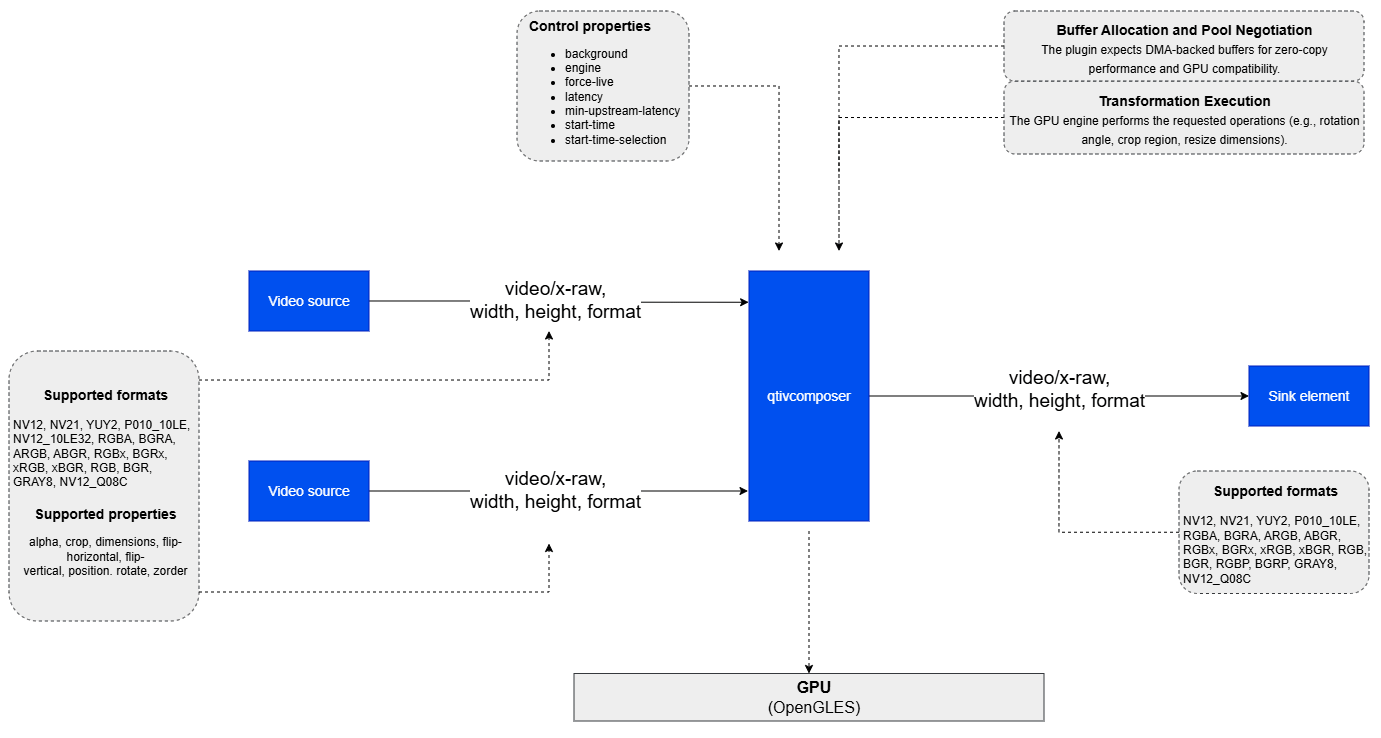
qtivcomposer is a video composition element that combines multiple video streams into a single output frame using GPU hardware acceleration. At a fundamental level, video composition involves taking multiple independent video frames and arranging them into one output frame according to defined spatial rules. These rules determine the position of each input frame and, when necessary, resize it to fit its destination window in the output frame. Resizing may involve either downscaling or upscaling, depending on the source and destination rectangles. qtivcomposer is commonly used in scenarios such as:
  • Multi-camera systems, such as surround-view and security grid layouts
  • Picture-in-picture compositions
  • Video wall applications
  • Overlaying auxiliary video streams onto a primary video feed
The element is optimized for real-time, low-latency pipelines and is designed to operate efficiently on platforms that provide GPU or dedicated hardware composition engines. Unlike software-based compositors, which rely on CPU memory copies and pixel-by-pixel processing, qtivcomposer leverages hardware acceleration to reduce memory bandwidth usage and lower end-to-end latency. By enforcing strict buffer requirements and separating layout definition from execution, the plugin provides a hardware-accelerated, deterministic, and scalable solution for video composition in GStreamer pipelines.

Example Pipeline

1

Download Required Files

FileDownloadSave as
Sample videoInput videoDraw_1080p_180s_30FPS.mp4
2

Copy files to device

# Replace $HOME to the appropriate device path before running the commands.
# For QLI:    /root
# For Ubuntu: /home/ubuntu
# Modify this based on your platform and ensure files are copied to the correct location on the device.
# Run from your host machine — replace <user> and <device-ip>

ssh <user>@<device-ip> "mkdir -p $HOME/{media,media/output}"
scp Draw_1080p_180s_30FPS.mp4   <user>@<device-ip>:$HOME/media/
3

Connect to device

# Run from your host machine — replace <user> and <device-ip>
ssh <user>@<device-ip>
4

Set environment variables

Run below command on your device
mkdir -p $HOME/{media,media/output}
export SRC_VIDEO_NAME=Draw_1080p_180s_30FPS.mp4
5

Run the pipeline

gst-launch-1.0 -e --gst-debug=2 \
filesrc location=$HOME/media/$SRC_VIDEO_NAME ! qtdemux ! h264parse ! \
v4l2h264dec capture-io-mode=4 output-io-mode=4 ! video/x-raw,format=NV12 ! queue ! tee name=t \
t. ! queue ! qtivcomposer name=mixer sink_0::dimensions="<960,540>" sink_1::dimensions="<960,540>" ! \
queue ! waylandsink fullscreen=true sync=false \
t. ! queue ! mixer.

Hierarchy

GObject
   GstObject
      GstElement
         GstAggregator
            GstVideoAggregator
               qtivcomposer

Pad Templates

sink

Capabilities
video/x-rawformat: { NV12, NV21, UYVY, YUY2, P010_10LE, RGBA, BGRA, ARGB, ABGR, RGBx, BGRx, xRGB, xBGR, RGB, BGR, GRAY8, NV12_Q08C }
width: [1, 32767]
height: [1, 32767]
framerate: [0/1, 255/1]
Availability: On request
Direction: sink

src

Capabilities
video/x-rawformat: { NV12, NV21, UYVY, YUY2, P010_10LE, RGBA, BGRA, ARGB, ABGR, RGBx, BGRx, xRGB, xBGR, RGB, BGR, GRAY8, NV12_Q08C }
width: [1, 32767]
height: [1, 32767]
framerate: [0/1, 255/1]
Presence: Always
Direction: source

Pad Properties

sink

PropertyDescription
alphaAlpha channel value.

Type: Double
Default: 1
Range: 0 - 1
Flags: readable/writable
cropThe crop rectangle in the format <X, Y, WIDTH, HEIGHT>.

Type: GstValueArray of type gint
Default: "<0, 0, 0, 0>"
Flags: readable/writable
Example: crop="<0,0,1280,720>"
dimensionsThe destination rectangle width and height. If not set, it remains the same as input dimensions in the format <WIDTH, HEIGHT>.

Type: GstValueArray of type gint
Default: "< >"
Flags: readable/writable
Example: crop="<1280,720>"
flip-horizontalFlips the video frame horizontally.

Type: Boolean
Default: false
Flags: readable/writable
flip-verticalFlips the video frame vertically.

Type: Boolean
Default: false
Flags: readable/writable
positionThe X and Y coordinates of the destination rectangle’s top-left corner in the format <X, Y>.

Type: GstValueArray of type gint
Default: "< >"
Flags: readable/writable
Example: position="<10,20>"
rotateSpecifies rotation to apply to the video.

Type: Enum
Default: 0, "none"
Range:
    (0): none
    (1): 90CW - Rotate 90 degrees clockwise
    (2): 90CCW - Rotate 90 degrees counter-clockwise
    (3): 180 - Rotate 180 degrees
Flags: readable/writable
Example: rotate="90CW" (or) rotate=1
zorderZ-axis order. By default, follows the order of creation.

Type: Integer
Default: -1
Range: -1 - 2147483647
Flags: readable/writable

Element Properties

PropertyDescription
backgroundBackground color.

Type: Unsigned Integer
Default: 4286611584
Range: 0 - 4294967295
Flags: readable/writable
engineEngine backend used for the conversion operations.

Type: Enum
Default: 2, "gles"
Range:
    (0): none - No backend used
    (2): gles - Use OpenGLES based video converter
    (3): fcv - Use FastCV based video converter
Flags: readable/writable
Example: engine="gles" (or) engine=2

Architecture, Processing, and Role in Vision AI

qtivcomposer is a multi-sink GStreamer element with one source pad. Each sink pad accepts one input stream, typically through dynamically requested pads such as sink_0, sink_1, and so on. The source pad produces the final composed frame. Internally, the element includes four main parts: a pad manager that tracks active inputs, a layout configuration that defines where and how each input appears in the output, a hardware composition backend that performs the composition, and a buffer manager that enforces DMA-compatible memory usage. At setup time, caps negotiation defines the output frame, including resolution and color format. Input streams must be compatible with the compositor. When needed, hardware-supported scaling and format conversion are applied during composition. Each sink pad is configured with layout metadata that specifies:
  • Output position (x, y)
  • Output size (width, height)
  • Z-order
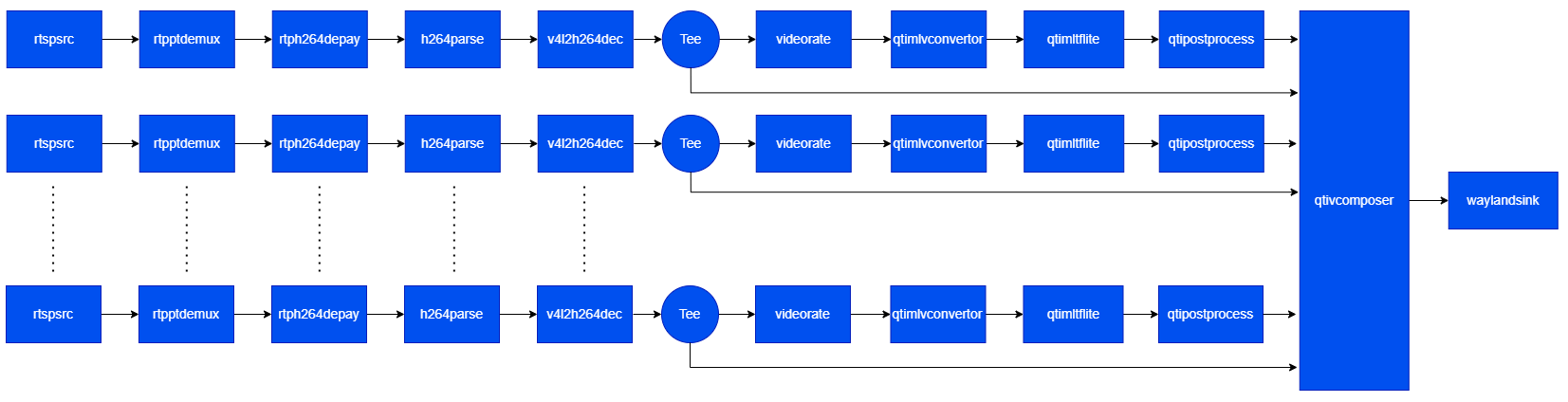
These settings are typically provided through element or per-pad properties. The properties are parsed into an internal layout structure that describes the final output frame independently of buffer arrival order. This separation keeps composition deterministic and reproducible. During runtime, each sink pad receives buffers independently. To generate a valid output frame, qtivcomposer synchronizes inputs by presentation time and ensures that all required frames are available. If a frame is missing or delayed, the element may reuse the previous frame, drop the output frame, or stall, depending on configuration. qtivcomposer operates only on DMA-backed buffers. This allows the hardware backend to access memory directly without CPU copies, enabling zero-copy operation, hardware interoperability, and predictable latency. If upstream does not provide suitable buffers, the element advertises its own buffer pool through GStreamer allocation negotiation. If compatible allocation cannot be established, pipeline setup fails rather than falling back to software memory. Once the required input buffers are ready, the hardware backend reads each frame, applies scaling, positioning, and any supported blending, and draws the inputs onto the output surface in Z-order. The composed frame is then pushed downstream to encoders, display sinks, or network outputs with a consistent format and timeline. In multi-stream vision AI pipelines, qtivcomposer is not only a display component but also a performance optimization stage. It combines multiple AI-processed streams into a single output surface, reducing memory bandwidth pressure, CPU overhead, GPU context switching, and cross-stream synchronization cost. In a typical IMSDK pipeline, each stream is decoded, preprocessed, inferred, and post-processed independently, with overlays such as boxes or labels applied per stream. The streams are merged only at the final stage by qtivcomposer, which preserves parallel processing while making final output efficient.

Usage

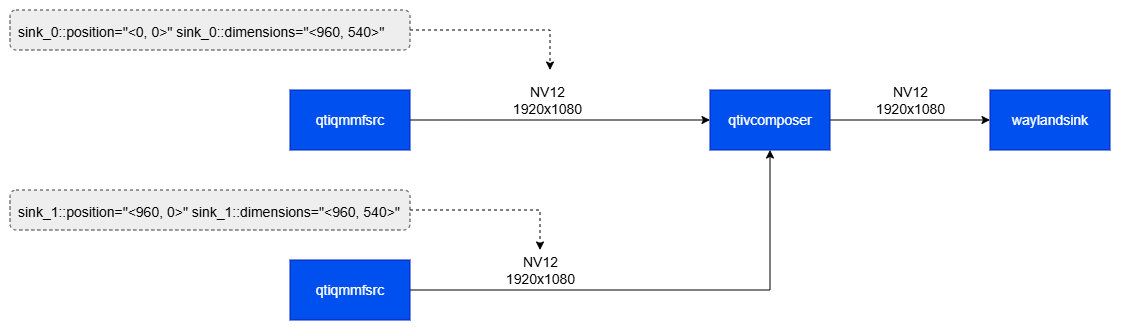
Side-by-side composition of two camera streams

This pipeline uses qtivcomposer to combine two NV12 camera streams into a single output frame arranged side by side, with the resulting output displayed on the screen.
gst-launch-1.0 \
  qtivcomposer name=mixer \
  sink_0::position="<0, 0>" sink_0::dimensions="<960, 540>" \
  sink_1::position="<960, 0>" sink_1::dimensions="<960, 540>" \
  ! waylandsink fullscreen=true async=true sync=false \
  qticamsrc camera=0 ! video/x-raw,format=NV12,width=1280,height=720 ! mixer. \
  qticamsrc camera=1 ! video/x-raw,format=NV12,width=1280,height=720 ! mixer.

Picture-in-picture (PiP) composition of two camera streams

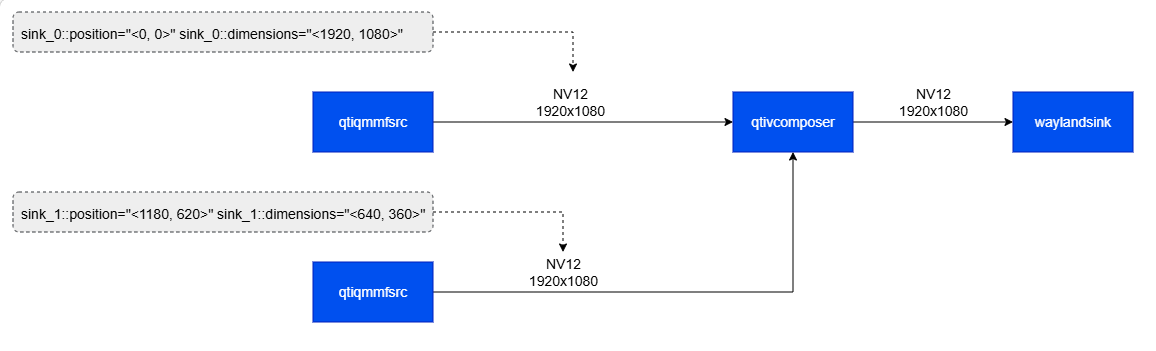
This example uses qtivcomposer to overlay a secondary video stream on top of a primary stream, creating a PiP layout in a single output frame.
gst-launch-1.0 \
  qtivcomposer name=mixer \
  sink_0::position="<0, 0>" sink_0::dimensions="<1920, 1080>" \
  sink_1::position="<1180, 620>" sink_1::dimensions="<640, 360>" \
  ! waylandsink fullscreen=true async=true sync=false
  qticamsrc camera=0 ! video/x-raw,format=NV12,width=1920,height=1080 ! mixer. \
  qticamsrc camera=1 ! video/x-raw,format=NV12,width=1920,height=1080 ! mixer.

Multi‑Stream Vision AI Video Wall

This example demonstrates how qtivcomposer serves as the final aggregation point for building an video wall, where each stream runs its own AI inference pipeline, applies AI Metadata as overlay, and is then composed into a single output to create the final video wall.
1

Download Required Files

FileDownloadSave as
YOLO modelQualcomm Modelyolov8_det_quantized.tflite
YOLO labelsLabelsyolov8.json
2

Copy files to device

ssh <user>@<device-ip> "mkdir -p $HOME/{models,labels}"
scp yolov8_det_quantized.tflite <user>@<device-ip>:$HOME/models/
scp yolov8.json                <user>@<device-ip>:$HOME/labels/
3

Connect to device

ssh <user>@<device-ip>
4

Set environment variables

Run below command on your device
mkdir -p $HOME/{models,labels}
5

Run the pipeline

gst-launch-1.0 -v qtivcomposer background=0x000000FF name=mix \
sink_0::position="&lt;0,     0&gt;" sink_0::dimensions="&lt;640,  360&gt;" \
sink_1::position="&lt;640,   0&gt;" sink_1::dimensions="&lt;640,  360&gt;" \
sink_2::position="&lt;1280,  0&gt;" sink_2::dimensions="&lt;640,  360&gt;" \
sink_3::position="&lt;0,    360&gt;" sink_3::dimensions="&lt;640, 360&gt;" \
sink_4::position="&lt;640,  360&gt;" sink_4::dimensions="&lt;640, 360&gt;" \
sink_5::position="&lt;1280, 360&gt;" sink_5::dimensions="&lt;640, 360&gt;" \
sink_6::position="&lt;0,    720&gt;" sink_6::dimensions="&lt;640, 360&gt;" \
sink_7::position="&lt;640,  720&gt;" sink_7::dimensions="&lt;640, 360&gt;" \
sink_8::position="&lt;1280, 720&gt;" sink_8::dimensions="&lt;640, 360&gt;" \
sink_9::position="&lt;0,      0&gt;" sink_9::dimensions="&lt;640,  360&gt;" \
sink_10::position="&lt;640,   0&gt;"  sink_10::dimensions="&lt;640, 360&gt;" \
sink_11::position="&lt;1280,  0&gt;"  sink_11::dimensions="&lt;640, 360&gt;" \
sink_12::position="&lt;0,    360&gt;" sink_12::dimensions="&lt;640, 360&gt;" \
sink_13::position="&lt;640,  360&gt;" sink_13::dimensions="&lt;640, 360&gt;" \
sink_14::position="&lt;1280, 360&gt;" sink_14::dimensions="&lt;640, 360&gt;" \
sink_15::position="&lt;0,    720&gt;" sink_15::dimensions="&lt;640, 360&gt;" \
sink_16::position="&lt;640,  720&gt;" sink_16::dimensions="&lt;640, 360&gt;" \
sink_17::position="&lt;1280, 720&gt;" sink_17::dimensions="&lt;640, 360&gt;" \
mix. ! queue ! fpsdisplaysink text-overlay=false sync=true video-sink="waylandsink fullscreen=true async=true sync=true" \
rtspsrc location=rtsp://admin:qualcomm1@192.168.0.14:554/Streaming/Channels/101 ! queue ! rtpptdemux ! rtph264depay ! h264parse ! v4l2h264dec capture-io-mode=4 output-io-mode=4 ! video/x-raw, format=NV12 ! queue ! tee name=t0  ! queue ! mix. \
rtspsrc location=rtsp://admin:qualcomm1@192.168.0.14:554/Streaming/Channels/101 ! queue ! rtpptdemux ! rtph264depay ! h264parse ! v4l2h264dec capture-io-mode=4 output-io-mode=4 ! video/x-raw, format=NV12 ! queue ! tee name=t1  ! queue ! mix. \
rtspsrc location=rtsp://admin:qualcomm1@192.168.0.14:554/Streaming/Channels/101 ! queue ! rtpptdemux ! rtph264depay ! h264parse ! v4l2h264dec capture-io-mode=4 output-io-mode=4 ! video/x-raw, format=NV12 ! queue ! tee name=t2  ! queue ! mix. \
rtspsrc location=rtsp://admin:qualcomm1@192.168.0.14:554/Streaming/Channels/101 ! queue ! rtpptdemux ! rtph264depay ! h264parse ! v4l2h264dec capture-io-mode=4 output-io-mode=4 ! video/x-raw, format=NV12 ! queue ! tee name=t3  ! queue ! mix. \
rtspsrc location=rtsp://admin:qualcomm1@192.168.0.14:554/Streaming/Channels/101 ! queue ! rtpptdemux ! rtph264depay ! h264parse ! v4l2h264dec capture-io-mode=4 output-io-mode=4 ! video/x-raw, format=NV12 ! queue ! tee name=t4  ! queue ! mix. \
rtspsrc location=rtsp://admin:qualcomm1@192.168.0.14:554/Streaming/Channels/101 ! queue ! rtpptdemux ! rtph264depay ! h264parse ! v4l2h264dec capture-io-mode=4 output-io-mode=4 ! video/x-raw, format=NV12 ! queue ! tee name=t5  ! queue ! mix. \
rtspsrc location=rtsp://admin:qualcomm1@192.168.0.14:554/Streaming/Channels/101 ! queue ! rtpptdemux ! rtph264depay ! h264parse ! v4l2h264dec capture-io-mode=4 output-io-mode=4 ! video/x-raw, format=NV12 ! queue ! tee name=t6  ! queue ! mix. \
rtspsrc location=rtsp://admin:qualcomm1@192.168.0.14:554/Streaming/Channels/101 ! queue ! rtpptdemux ! rtph264depay ! h264parse ! v4l2h264dec capture-io-mode=4 output-io-mode=4 ! video/x-raw, format=NV12 ! queue ! tee name=t7  ! queue ! mix. \
rtspsrc location=rtsp://admin:qualcomm1@192.168.0.14:554/Streaming/Channels/101 ! queue ! rtpptdemux ! rtph264depay ! h264parse ! v4l2h264dec capture-io-mode=4 output-io-mode=4 ! video/x-raw, format=NV12 ! queue ! tee name=t8  ! queue ! mix. \
split0.  ! videorate drop-only=true ! video/x-raw,framerate=15/1 ! queue ! qtimlvconverter ! queue ! qtimltflite delegate=external external-delegate-path=libQnnTFLiteDelegate.so external-delegate-options="QNNExternalDelegate,backend_type=htp;" model=$HOME/models/yolov8_det_quantized.tflite ! queue ! qtimlpostprocess module=yolov8 labels=$HOME/models/yolov8.json settings="{\"confidence\": 50.0}" ! queue ! mix. \

split1.  ! videorate drop-only=true ! video/x-raw,framerate=15/1 ! queue ! qtimlvconverter ! queue ! qtimltflite delegate=external external-delegate-path=libQnnTFLiteDelegate.so external-delegate-options="QNNExternalDelegate,backend_type=htp;" model=$HOME/models/yolov8_det_quantized.tflite ! queue ! qtimlpostprocess module=yolov8 labels=$HOME/models/yolov8.json settings="{\"confidence\": 50.0}" ! queue ! mix. \

split2.  ! videorate drop-only=true ! video/x-raw,framerate=15/1 ! queue ! qtimlvconverter ! queue ! qtimltflite delegate=external external-delegate-path=libQnnTFLiteDelegate.so external-delegate-options="QNNExternalDelegate,backend_type=htp;" model=$HOME/models/yolov8_det_quantized.tflite ! queue ! qtimlpostprocess module=yolov8 labels=$HOME/models/yolov8.json settings="{\"confidence\": 50.0}" ! queue ! mix. \
split3.  ! videorate drop-only=true ! video/x-raw,framerate=15/1 ! queue ! qtimlvconverter ! queue ! qtimltflite delegate=external external-delegate-path=libQnnTFLiteDelegate.so external-delegate-options="QNNExternalDelegate,backend_type=htp;" model=$HOME/models/yolov8_det_quantized.tflite ! queue ! qtimlpostprocess module=yolov8 labels=$HOME/models/yolov8.json settings="{\"confidence\": 50.0}" ! queue ! mix. \
split4.  ! videorate drop-only=true ! video/x-raw,framerate=15/1 ! queue ! qtimlvconverter ! queue ! qtimltflite delegate=external external-delegate-path=libQnnTFLiteDelegate.so external-delegate-options="QNNExternalDelegate,backend_type=htp;" model=$HOME/models/yolov8_det_quantized.tflite ! queue ! qtimlpostprocess module=yolov8 labels=$HOME/models/yolov8.json settings="{\"confidence\": 50.0}" ! queue ! mix. \
split5.  ! videorate drop-only=true ! video/x-raw,framerate=15/1 ! queue ! qtimlvconverter ! queue ! qtimltflite delegate=external external-delegate-path=libQnnTFLiteDelegate.so external-delegate-options="QNNExternalDelegate,backend_type=htp;" model=$HOME/models/yolov8_det_quantized.tflite ! queue ! qtimlpostprocess module=yolov8 labels=$HOME/models/yolov8.json settings="{\"confidence\": 50.0}" ! queue ! mix. \
split6.  ! videorate drop-only=true ! video/x-raw,framerate=15/1 ! queue ! qtimlvconverter ! queue ! qtimltflite delegate=external external-delegate-path=libQnnTFLiteDelegate.so external-delegate-options="QNNExternalDelegate,backend_type=htp;" model=$HOME/models/yolov8_det_quantized.tflite ! queue ! qtimlpostprocess module=yolov8 labels=$HOME/models/yolov8.json settings="{\"confidence\": 50.0}" ! queue ! mix. \
split7.  ! videorate drop-only=true ! video/x-raw,framerate=15/1 ! queue ! qtimlvconverter ! queue ! qtimltflite delegate=external external-delegate-path=libQnnTFLiteDelegate.so external-delegate-options="QNNExternalDelegate,backend_type=htp;" model=$HOME/models/yolov8_det_quantized.tflite ! queue ! qtimlpostprocess module=yolov8 labels=$HOME/models/yolov8.json settings="{\"confidence\": 50.0}" ! queue ! mix. \
split8.  ! videorate drop-only=true ! video/x-raw,framerate=15/1 ! queue ! qtimlvconverter ! queue ! qtimltflite delegate=external external-delegate-path=libQnnTFLiteDelegate.so external-delegate-options="QNNExternalDelegate,backend_type=htp;" model=$HOME/models/yolov8_det_quantized.tflite ! queue ! qtimlpostprocess module=yolov8 labels=$HOME/models/yolov8.json settings="{\"confidence\": 50.0}" ! queue ! mix.