> ## Documentation Index
> Fetch the complete documentation index at: https://dragonwingdocs.qualcomm.com/llms.txt
> Use this file to discover all available pages before exploring further.
# Camera QuickStart Guide
> Connect camera sensors to your reference hardware platform and stream using GStreamer and V4L2 APIs — QCS6490, IQ-9075-EVK, IQ-8275-EVK, and IQ615.
QCS6490
IQ-9075-EVK
IQ-8275-EVK
IQ615
Stable
Multi-platform support
Primary API
***
This page describes how to connect camera sensors to your reference hardware platform and make it up and running in 3 Simple steps.
***
### 📸 Get QCS6490 Camera Up and Running in 3 Simple Steps
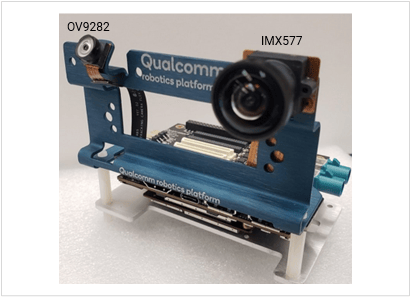
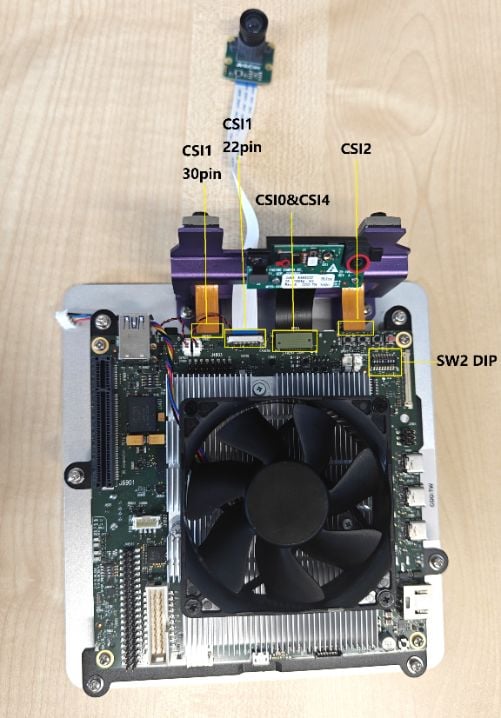
QCS6490 ships with both IMX577 and OV9282 pre-connected, as shown below.
Connect to the device console using SSH.
See [How To SSH?](https://dragonwingdocs.qualcomm.com/Linux/devices/iq9075-evk/set-up-the-device#connect-over-ssh) for instructions.
We recommend using the [Qualcomm Launcher](https://dragonwingdocs.qualcomm.com/Tools/Qualcomm-Launcher/flash-os#flashing-steps) tool for build flashing, as it handles all required configurations internally. If you are not using Qualcomm Launcher, follow the manual steps below to enable camera functionality.
Flash the Config2 image to use gst-launch-1.0 and the GStreamer plugins.
On Qualcomm Linux 2.0, qcom-multimedia-proprietary-image includes the downstream camera packages by default, but camera functionality is not enabled automatically.
Enable camera support on qcom-multimedia-proprietary-image by running the following command in the device shell:
```bash Terminal theme={null}
echo -n "camx" > /var/data
efivar -n 882f8c2b-9646-435f-8de5-f208ff80c1bd-VendorDtbOverlays -w -f /var/data
efivar -n 882f8c2b-9646-435f-8de5-f208ff80c1bd-VendorDtbOverlays -p
sync
reboot
```
If a GStreamer command was executed before enabling the camera overlay, the GStreamer registry must be cleared after enabling the camera overlay. Run the following command to clear the registry:
```bash Terminal theme={null}
rm ~/.cache/gstreamer-1.0/registry.aarch64.bin
```
Camera use-cases are expected to run on a performance (perf) build for optimal results. On default builds, reduce the kernel console log level as shown below:
```bash Terminal theme={null}
echo 4 > /proc/sys/kernel/printk
```
#### Video encoding
Run the following command in the device terminal:
```bash GStreamer (MP4 Record) theme={null}
gst-launch-1.0 -e qtiqmmfsrc name=camsrc camera=0 ! \
video/x-raw,format=NV12,width=1280,height=720,framerate=30/1,\
interlace-mode=progressive,colorimetry=bt601 ! v4l2h264enc \
capture-io-mode=4 output-io-mode=5 extra-controls="controls,video_bitrate=6000000,\
video_bitrate_mode=0;" ! h264parse ! mp4mux ! filesink location=/opt/mux_avc.mp4
```
This command starts the camera with 720p at 30 FPS configuration and saves it as a video file after h264 video encoding. If the gst pipeline status is changed to "PLAYING", this indicates the camera is running.
To stop the camera, press **CTRL+C**.
`/opt/mux_avc.mp4` is generated on the device. The recorded content can be pulled from the device by running the following scp command on the host PC:
```bash SCP (SSH) theme={null}
$ scp -r root@[ip-addr]:/opt/mux_avc.mp4 .
```
### 📸 Get IQ-8275-EVK Camera up and running in 3 Simple steps.
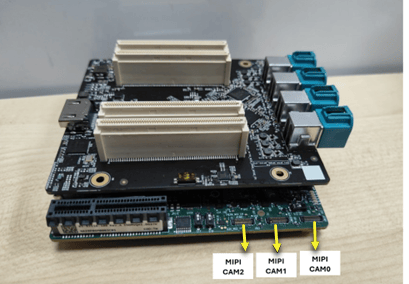
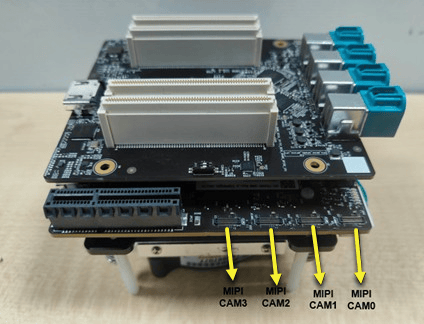
Connect the IMX577 MIPI camera sensor to any of the MIPI CSI slots of the IQ-8275-EVK device.
Connect to the device console using SSH.
See [How To SSH?](https://dragonwingdocs.qualcomm.com/Linux/devices/iq9075-evk/set-up-the-device#connect-over-ssh) for instructions.
We recommend using the [Qualcomm Launcher](https://dragonwingdocs.qualcomm.com/Tools/Qualcomm-Launcher/flash-os#flashing-steps) tool for build flashing, as it handles all required configurations internally. If you are not using Qualcomm Launcher, follow the manual steps below to enable camera functionality.
Flash the Config2 image to use gst-launch-1.0 and the GStreamer plugins.
On Qualcomm Linux 2.0, qcom-multimedia-proprietary-image includes the downstream camera packages by default, but camera functionality is not enabled automatically.
Enable camera support on qcom-multimedia-proprietary-image by running the following command in the device shell:
```bash Terminal theme={null}
echo -n "camx" > /var/data
efivar -n 882f8c2b-9646-435f-8de5-f208ff80c1bd-VendorDtbOverlays -w -f /var/data
efivar -n 882f8c2b-9646-435f-8de5-f208ff80c1bd-VendorDtbOverlays -p
sync
reboot
```
If a GStreamer command was executed before enabling the camera overlay, the GStreamer registry must be cleared after enabling the camera overlay. Run the following command to clear the registry:
```bash Terminal theme={null}
rm ~/.cache/gstreamer-1.0/registry.aarch64.bin
```
Camera basic use-case is not working on IQ8. Refer to the known [camera issue](https://dragonwingdocs.qualcomm.com/Key-Documents/Software-Release-Notes/limitations#iq8) in the IQ8 limitations section.
**To resolve this issue, apply the following fix:**
**For build users:** Run the following commands:
```bash Terminal theme={null}
git clone https://github.com/qualcomm-linux/meta-qcom -b qli-2.0
cd meta-qcom
git fetch origin pull/2619/head
git cherry-pick 1e885404be0191a7b89bd853aba4ef6c28b9295f^..2a1a38963d40b8da079a7b640b363070d9eee18f
cd ..
kas build meta-qcom/ci/iq-8275-evk.yml:meta-qcom/ci/qcom-distro.yml
```
**For prebuilt users:** Run the following command before running the Camera use-case:
```bash Terminal theme={null}
cp /usr/share/qcom/sa8775p/Qualcomm/SA8775P-RIDE/dsp/cdsp/libbitml_nsp_73nb_skel.so /usr/share/qcom/qcs8300/Qualcomm/IQ8275-EVK/dsp/cdsp/.
```
Camera use-cases are expected to run on a performance (perf) build for optimal results. On default builds, reduce the kernel console log level as shown below:
```bash Terminal theme={null}
echo 4 > /proc/sys/kernel/printk
```
#### Video encoding
Run the following command in the device terminal:
```bash GStreamer (MP4 Record) theme={null}
gst-launch-1.0 -e qtiqmmfsrc name=camsrc camera=0 ! \
video/x-raw,format=NV12,width=1280,height=720,framerate=30/1,\
interlace-mode=progressive,colorimetry=bt601 ! v4l2h264enc \
capture-io-mode=4 output-io-mode=5 extra-controls="controls,video_bitrate=6000000,\
video_bitrate_mode=0;" ! h264parse ! mp4mux ! filesink location=/opt/mux_avc.mp4
```
This command starts the camera with 720p at 30 FPS configuration and saves it as a video file after h264 video encoding. If the gst pipeline status is changed to "PLAYING", this indicates the camera is running.
To stop the camera, press **CTRL+C**.
`/opt/mux_avc.mp4` is generated on the device. The recorded content can be pulled from the device by running the following scp command on the host PC:
```bash SCP (SSH) theme={null}
$ scp -r root@[ip-addr]:/opt/mux_avc.mp4 .
```
### 📸 Get IQ-9075-EVK Camera up and running in 3 Simple steps.
Connect the IMX577 MIPI camera sensor to any of the MIPI CSI slots of the IQ-9075-EVK device.
Connect to the device console using SSH.
See [How To SSH?](https://dragonwingdocs.qualcomm.com/Linux/devices/iq9075-evk/set-up-the-device#connect-over-ssh) for instructions.
We recommend using the [Qualcomm Launcher](https://dragonwingdocs.qualcomm.com/Tools/Qualcomm-Launcher/flash-os#flashing-steps) tool for build flashing, as it handles all required configurations internally. If you are not using Qualcomm Launcher, follow the manual steps below to enable camera functionality.
Flash the Config2 image to use gst-launch-1.0 and the GStreamer plugins.
On Qualcomm Linux 2.0, qcom-multimedia-proprietary-image includes the downstream camera packages by default, but camera functionality is not enabled automatically.
Enable camera support on qcom-multimedia-proprietary-image by running the following command in the device shell:
```bash Terminal theme={null}
echo -n "camx" > /var/data
efivar -n 882f8c2b-9646-435f-8de5-f208ff80c1bd-VendorDtbOverlays -w -f /var/data
efivar -n 882f8c2b-9646-435f-8de5-f208ff80c1bd-VendorDtbOverlays -p
sync
reboot
```
If a GStreamer command was executed before enabling the camera overlay, the GStreamer registry must be cleared after enabling the camera overlay. Run the following command to clear the registry:
```bash Terminal theme={null}
rm ~/.cache/gstreamer-1.0/registry.aarch64.bin
```
Camera use-cases are expected to run on a performance (perf) build for optimal results. On default builds, reduce the kernel console log level as shown below:
```bash Terminal theme={null}
echo 4 > /proc/sys/kernel/printk
```
#### Video encoding
Run the following command in the device terminal:
```bash GStreamer (MP4 Record) theme={null}
gst-launch-1.0 -e qtiqmmfsrc name=camsrc camera=0 ! \
video/x-raw,format=NV12,width=1280,height=720,framerate=30/1,\
interlace-mode=progressive,colorimetry=bt601 ! v4l2h264enc \
capture-io-mode=4 output-io-mode=5 extra-controls="controls,video_bitrate=6000000,\
video_bitrate_mode=0;" ! h264parse ! mp4mux ! filesink location=/opt/mux_avc.mp4
```
This command starts the camera with 720p at 30 FPS configuration and saves it as a video file after h264 video encoding. If the gst pipeline status is changed to "PLAYING", this indicates the camera is running.
To stop the camera, press **CTRL+C**.
`/opt/mux_avc.mp4` is generated on the device. The recorded content can be pulled from the device by running the following scp command on the host PC:
```bash SCP (SSH) theme={null}
$ scp -r root@[ip-addr]:/opt/mux_avc.mp4 .
```
### 📸 Get IQ615 Camera up and running in 3 Simple steps.
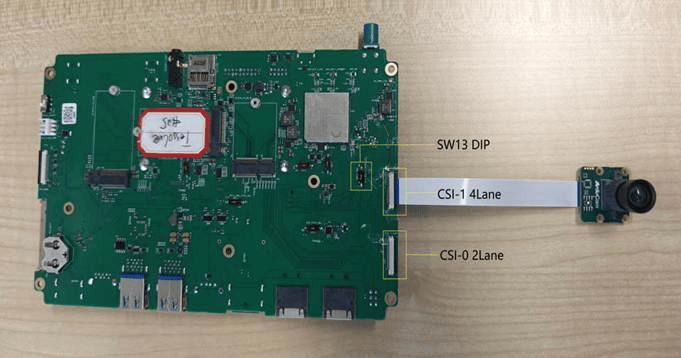
Connect the IMX577 MIPI camera sensor to the CAM1 slot of the IQ615 device.
Connect to the device console using SSH.
See [How To SSH?](https://dragonwingdocs.qualcomm.com/Linux/devices/iq9075-evk/set-up-the-device#connect-over-ssh) for instructions.
We recommend using the [Qualcomm Launcher](https://dragonwingdocs.qualcomm.com/Tools/Qualcomm-Launcher/flash-os#flashing-steps) tool for build flashing, as it handles all required configurations internally. If you are not using Qualcomm Launcher, follow the manual steps below to enable camera functionality.
Flash the Config2 image to use gst-launch-1.0 and the GStreamer plugins.
On Qualcomm Linux 2.0, qcom-multimedia-proprietary-image includes the downstream camera packages by default, but camera functionality is not enabled automatically.
Enable camera support on qcom-multimedia-proprietary-image by running the following command in the device shell:
```bash Terminal theme={null}
echo -n "camx" > /var/data
efivar -n 882f8c2b-9646-435f-8de5-f208ff80c1bd-VendorDtbOverlays -w -f /var/data
efivar -n 882f8c2b-9646-435f-8de5-f208ff80c1bd-VendorDtbOverlays -p
sync
reboot
```
If a GStreamer command was executed before enabling the camera overlay, the GStreamer registry must be cleared after enabling the camera overlay. Run the following command to clear the registry:
```bash Terminal theme={null}
rm ~/.cache/gstreamer-1.0/registry.aarch64.bin
```
Camera use-cases are expected to run on a performance (perf) build for optimal results. On default builds, reduce the kernel console log level as shown below:
```bash Terminal theme={null}
echo 4 > /proc/sys/kernel/printk
```
#### Video encoding
Run the following command in the device terminal:
```bash GStreamer (MP4 Record) theme={null}
gst-launch-1.0 -e qtiqmmfsrc name=camsrc camera=0 ! \
video/x-raw,format=NV12,width=1280,height=720,framerate=30/1,\
interlace-mode=progressive,colorimetry=bt601 ! v4l2h264enc \
capture-io-mode=4 output-io-mode=5 extra-controls="controls,video_bitrate=6000000,\
video_bitrate_mode=0;" ! h264parse ! mp4mux ! filesink location=/opt/mux_avc.mp4
```
This command starts the camera with 720p at 30 FPS configuration and saves it as a video file after h264 video encoding. If the gst pipeline status is changed to "PLAYING", this indicates the camera is running.
To stop the camera, press **CTRL+C**.
`/opt/mux_avc.mp4` is generated on the device. The recorded content can be pulled from the device by running the following scp command on the host PC:
```bash SCP (SSH) theme={null}
$ scp -r root@[ip-addr]:/opt/mux_avc.mp4 .
```
### 📸 Get IQx7181 Camera up and running in 3 Simple steps.
Connect the IMX577 MIPI camera sensor to the CAM1 (CSI1 22-pin) slot of the IQx7181 device.
Connect to the device console using SSH.
See [How To SSH?](https://dragonwingdocs.qualcomm.com/Linux/devices/iq9075-evk/set-up-the-device#connect-over-ssh) for instructions.
We recommend using the [Qualcomm Launcher](https://dragonwingdocs.qualcomm.com/Tools/Qualcomm-Launcher/flash-os#flashing-steps) tool for build flashing, as it handles all required configurations internally. If you are not using Qualcomm Launcher, follow the manual steps below to enable camera functionality.
Flash the Config2 image to use gst-launch-1.0 and the GStreamer plugins.
On Qualcomm Linux 2.0, qcom-multimedia-proprietary-image includes the downstream camera packages by default, but camera functionality is not enabled automatically.
Enable camera support on qcom-multimedia-proprietary-image by running the following command in the device shell:
```bash Terminal theme={null}
echo -n "camx" > /var/data
efivar -n 882f8c2b-9646-435f-8de5-f208ff80c1bd-VendorDtbOverlays -w -f /var/data
efivar -n 882f8c2b-9646-435f-8de5-f208ff80c1bd-VendorDtbOverlays -p
sync
reboot
```
If a GStreamer command was executed before enabling the camera overlay, the GStreamer registry must be cleared after enabling the camera overlay. Run the following command to clear the registry:
```bash Terminal theme={null}
rm ~/.cache/gstreamer-1.0/registry.aarch64.bin
```
Camera use-cases are expected to run on a performance (perf) build for optimal results. On default builds, reduce the kernel console log level as shown below:
```bash Terminal theme={null}
echo 4 > /proc/sys/kernel/printk
```
#### Video encoding
Run the following command in the device terminal:
```bash GStreamer (MP4 Record) theme={null}
gst-launch-1.0 -e qtiqmmfsrc name=camsrc camera=0 ! \
video/x-raw,format=NV12,width=1280,height=720,framerate=30/1,\
interlace-mode=progressive,colorimetry=bt601 ! v4l2h264enc \
capture-io-mode=4 output-io-mode=5 extra-controls="controls,video_bitrate=6000000,\
video_bitrate_mode=0;" ! h264parse ! mp4mux ! filesink location=/opt/mux_avc.mp4
```
This command starts the camera with 720p at 30 FPS configuration and saves it as a video file after h264 video encoding. If the gst pipeline status is changed to "PLAYING", this indicates the camera is running.
To stop the camera, press **CTRL+C**.
`/opt/mux_avc.mp4` is generated on the device. The recorded content can be pulled from the device by running the following scp command on the host PC:
```bash SCP (SSH) theme={null}
$ scp -r root@[ip-addr]:/opt/mux_avc.mp4 .
```