> ## Documentation Index
> Fetch the complete documentation index at: https://dragonwingdocs.qualcomm.com/llms.txt
> Use this file to discover all available pages before exploring further.
# Device overview
> Hardware overview of the Dragonwing IQ-8275 EVK including SoC features, peripherals, and board layout.
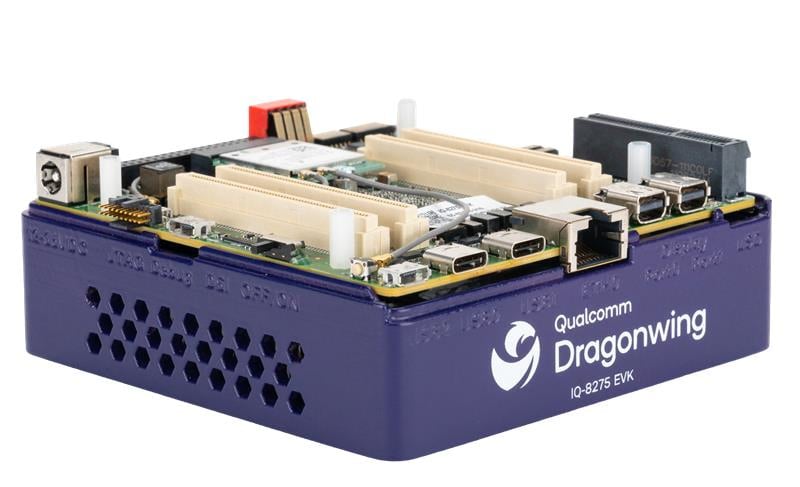
The Dragonwing IQ-8275 EVK features the Qualcomm Dragonwing™ IQ-8275 SoC, part of the IQ8 Series. This processor is engineered to deliver exceptional AI performance for industrial-grade applications operating in extreme environments. Designed for compute-intensive workloads, robotics, and edge AI, the IQ-8275 combines high-performance processing, advanced multimedia capabilities, and robust connectivity—all within a power-efficient architecture.
**Top View:**
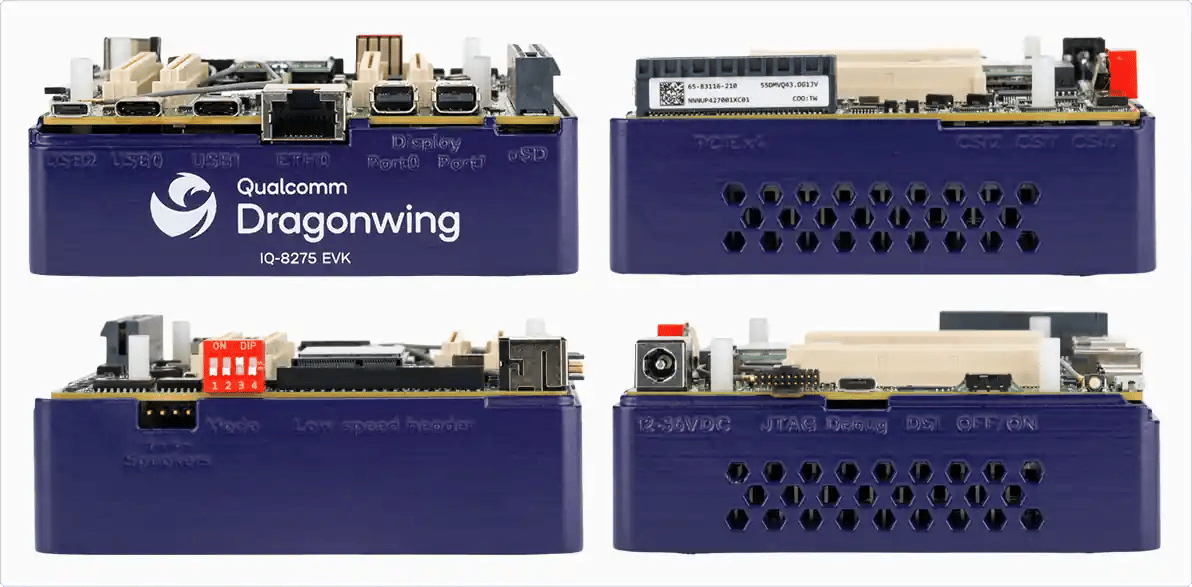
 **Side View:**
 ## Introduction
The Dragonwing IQ-8275 EVK incorporates a system-on-module (SoM) featuring the Qualcomm IQ-8275 system-on-chip (SoC). This SoM is mounted on the mainboard, which provides connectors for multiple peripheral interfaces and supports stackable mezzanine cards for expanded functionality. The platform is designed to manage concurrent compute and AI workloads efficiently.
**Key Features:**
* System-on-Module (SoM)
* Integrates the Qualcomm IQ-8275 SoC.
* Mounted on the mainboard for modular design.
* The IQ-8275 SoC is integrated within the IQ-8275M module, which also houses two PMICs and two LPDDR5 SDRAM memory components.
* Mainboard Capabilities
* Provides connectors for various peripheral interfaces.
* Supports stackable mezzanine cards for expansion.
* Performance and Workload Management
* Handles multiple concurrent compute and AI workloads efficiently.
* Peripheral Support
* Integrated Ethernet, USB, Wi-Fi, PCIe, and Bluetooth.
* AI Performance
* Delivers up to 40 INT8 TOPS, enabling high-performance AI-centric and edge computing applications in industrial environments.
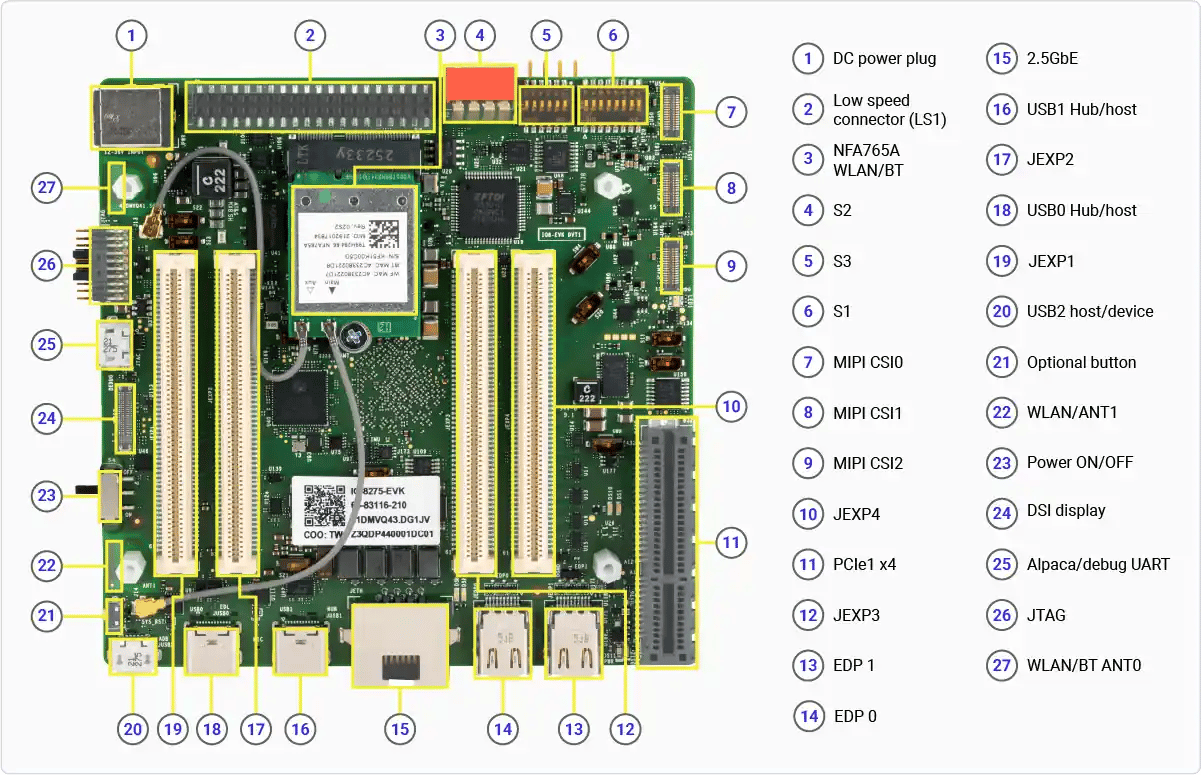
The following figure shows the location of the different connectors on the mainboard. It also shows the main components and ports including the power plug, power on-off switch, DIP switches, camera interfaces, USB ports, debug UART port, Ethernet port, and display ports.
## Introduction
The Dragonwing IQ-8275 EVK incorporates a system-on-module (SoM) featuring the Qualcomm IQ-8275 system-on-chip (SoC). This SoM is mounted on the mainboard, which provides connectors for multiple peripheral interfaces and supports stackable mezzanine cards for expanded functionality. The platform is designed to manage concurrent compute and AI workloads efficiently.
**Key Features:**
* System-on-Module (SoM)
* Integrates the Qualcomm IQ-8275 SoC.
* Mounted on the mainboard for modular design.
* The IQ-8275 SoC is integrated within the IQ-8275M module, which also houses two PMICs and two LPDDR5 SDRAM memory components.
* Mainboard Capabilities
* Provides connectors for various peripheral interfaces.
* Supports stackable mezzanine cards for expansion.
* Performance and Workload Management
* Handles multiple concurrent compute and AI workloads efficiently.
* Peripheral Support
* Integrated Ethernet, USB, Wi-Fi, PCIe, and Bluetooth.
* AI Performance
* Delivers up to 40 INT8 TOPS, enabling high-performance AI-centric and edge computing applications in industrial environments.
The following figure shows the location of the different connectors on the mainboard. It also shows the main components and ports including the power plug, power on-off switch, DIP switches, camera interfaces, USB ports, debug UART port, Ethernet port, and display ports.
 ## Device specifications
| **Category** | **Details** |
| ------------------------- | -------------------------------------------------------------------------------------------------------------------------------------------------------------------------------------------------------------------------------------------------------------------------------------------------------------------- |
| **Processor & Compute** | CPU: Octa-core Kryo™ Gen 6 (2× Prime @ 2.35 GHz, 2× Gold @ 2.1 GHz, 4× Silver @ 1.95 GHz)
## Device specifications
| **Category** | **Details** |
| ------------------------- | -------------------------------------------------------------------------------------------------------------------------------------------------------------------------------------------------------------------------------------------------------------------------------------------------------------------- |
| **Processor & Compute** | CPU: Octa-core Kryo™ Gen 6 (2× Prime @ 2.35 GHz, 2× Gold @ 2.1 GHz, 4× Silver @ 1.95 GHz)
GPU: Adreno™ 623 (up to 877 MHz) |
| **AI Engine** | Dual Hexagon Tensor Processors
Up to 40 TOPS AI performance
Supports LLMs (e.g., Llama2 13B at \~12 tokens/sec) |
| **Real-Time Subsystem** | Quad real-time cores @ 1.85 GHz for low-latency control |
| **Memory & Storage** | RAM: Up to 12 GB LPDDR5 @ 3200 MHz with inline ECC
Storage: UFS 3.1 (up to 128 GB), NVMe via PCIe |
| **Multimedia** | Camera Support: Up to 16 concurrent cameras
Display Support: Up to 12 displays (e.g., 5× 4K60, 8× 1080p60)
Video Decode: 2× 4K60, 4× 4K30, 8× 1080p60, 16× 1080p30 (Formats: AV1, H.264, H.265/HEVC, VP9, MPEG-2)
Video Encode: 1× 4K60, 2× 4K30, 4× 1080p60, 8× 1080p30 (Formats: H.264, H.265/HEVC) |
| **Connectivity** | Ethernet: 2× 2.5 GbE
Wireless: Wi-Fi 6E, Bluetooth 5.3
I/O Interfaces: PCIe, USB, CAN-FD, GPIO, UART, MIPI CSI/DSI |
| **Operating Temperature** | Industrial-grade:
Ambient: -40°C to +105°C
Junction: up to +125°C |
| **Target Applications** | Factory Automation
Edge AI and Generative AI
Robotics and industrial automation
Multi-camera vision systems
Autonomous Mobile Robots (AMRs)
Industrial gateways |
## Hardware Specifications
The following table outlines the key hardware specification of the Dragonwing IQ-8275 EVK.
| Interface or feature | Description |
| ----------------------------- | ------------------------------------------------------------------------------------------------------------------------------------------------------------------- |
| SoC | IQ-8275 (part of IQ-8275M) |
| Memory | 4 × 16 bit 12 GB LP5 3200 MHz (2 x 6 GB LPDDR5) |
| PMIC | 2 × PMM8620AU (part of IQ-8275M) |
| External MCU | Not present |
| Storage | 1 × 128 GB UFS, micro-SD card, EEPROMs for MACs, eMMC on mezzanine card |
| Display | Four display ports:
• 2 × mini-DP (one with MST)
• 2 × DSIs (one to DSI flex, one to expansion)
DSI flex connection with touchscreen |
| Camera/Video input | 3 × Quad deserializers
3 × CSI (C-PHY or D-PHY) |
| USB | USB0 Type-C (host or device mode)
USB1 Type-C (host mode)
USB2 micro-USB 2.0 (host or device mode) |
| WLAN/Bluetooth® | m.2 module (NFA765A)
2 × printed antennas (Bluetooth shared with one WLAN antenna) |
| PCIe | Mainboard supported or expanded options (selected through switch):
• 1 × PCIe x4 slot or expansion (switch)
• 1 × m.2 E key (Wi-Fi) or expansion (switch) |
| Audio | 1 × I2S mic
2 × I2S speaker amps
Additional I2S on GPIOs |
| Ethernet | RJ45 2.5 GbE SGMII |
| CAN/CAN-FD | 1 × CAN/CAN-FD on low speed header on mainboard |
| Low-speed expansion | 3.3 V header for developer community with CAN, SPI, I2C, UART, I2S |
| Second low-speed expansion | QUPs and GPIOs on mezzanine connectors |
| Sensors | IMU: ICM-42688
QUPs on expansion |
| Trusted platform module (TPM) | ST33HTPH2x32AHE4 on mainboard |
## Components included in the kit
**Packaging:**
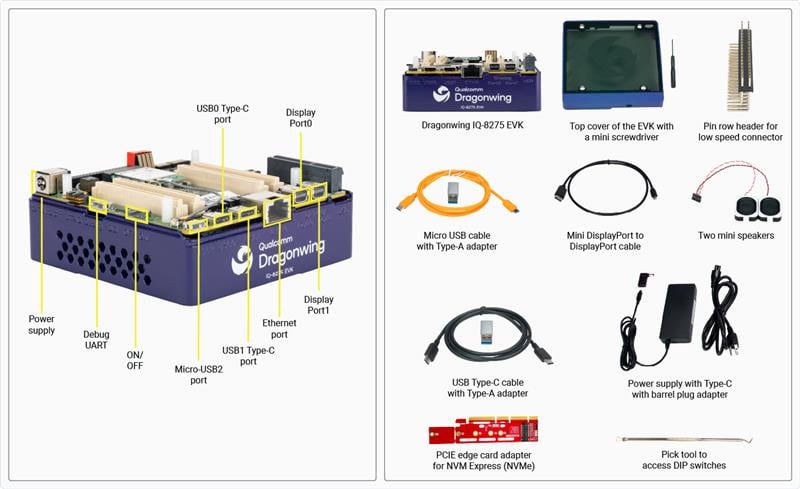 * Dragonwing IQ-8275 EVK
* Top cover of the EVK with a mini screwdriver
* Power supply with Type-C to barrel plug adapter
* USB Type-C cable with Type-A adapter
* Micro USB cable with Type-A adapter
* Mini DisplayPort to DisplayPort cable
* Two mini speakers
* PCIe edge card adapter for NVM Express (NVMe)
* Pick tool to access DIP switches
* Pin row header for low speed connector
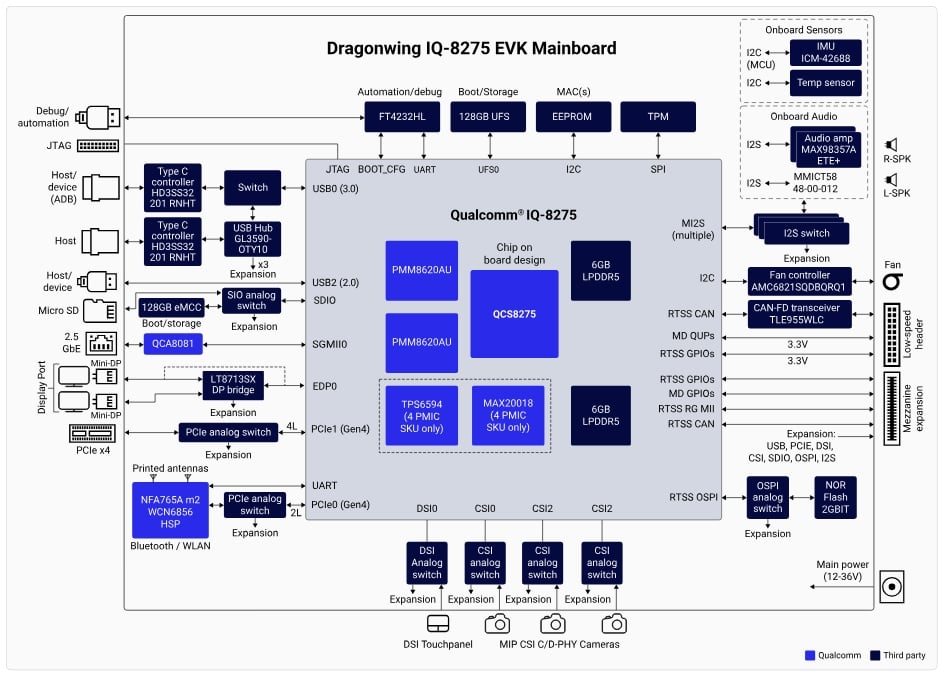
## System Block Diagram
This figure provides a visual representation of the platform’s architecture, highlighting the main components and their interactions on the Dragonwing IQ-8275 EVK platform.
* Dragonwing IQ-8275 EVK
* Top cover of the EVK with a mini screwdriver
* Power supply with Type-C to barrel plug adapter
* USB Type-C cable with Type-A adapter
* Micro USB cable with Type-A adapter
* Mini DisplayPort to DisplayPort cable
* Two mini speakers
* PCIe edge card adapter for NVM Express (NVMe)
* Pick tool to access DIP switches
* Pin row header for low speed connector
## System Block Diagram
This figure provides a visual representation of the platform’s architecture, highlighting the main components and their interactions on the Dragonwing IQ-8275 EVK platform.
 For more detailed hardware information, refer to the QCS8275 Data Sheet (80-73475-1) and IQ-8275 EVK documentation.
## Next steps
With the board unpacked and the layout understood, the first thing to do is install the latest software. Continue to [**Update software**](./update-software/overview).
For more detailed hardware information, refer to the QCS8275 Data Sheet (80-73475-1) and IQ-8275 EVK documentation.
## Next steps
With the board unpacked and the layout understood, the first thing to do is install the latest software. Continue to [**Update software**](./update-software/overview).