

Overview

qtimltflite is a GStreamer inference element that executes TensorFlow Lite models as part of AI and multimedia pipelines. The element operates entirely in tensor mode: it accepts input tensors on its sink pad and produces output tensors on its source pad according to the model’s input and output specifications. The element is limited to model execution. It does not perform preprocessing, tensor reshaping, batching, layout conversion, or model-specific post-processing. These functions are expected to be handled by adjacent elements in the pipeline. As a result, upstream elements must provide tensors that already match the model requirements, and downstream elements must interpret the output tensors produced by inference. qtimltflite supports multiple TensorFlow Lite execution backends through delegates, including CPU, GPU, and external delegate configurations. This allows the same pipeline structure to be deployed across different hardware targets and optimized for different performance, latency, and power requirements. The element is intended for real-time and embedded AI pipelines where inference is one stage in a larger modular processing flow.

Key Responsibilities

qtimltflite is responsible for:
  • Loading and executing a TensorFlow Lite model
  • Accepting preformatted input tensors from upstream elements
  • Producing output tensors that match the model output signature
  • Negotiating tensor data types and dimensions with adjacent elements
  • Propagating tensor metadata required by downstream elements
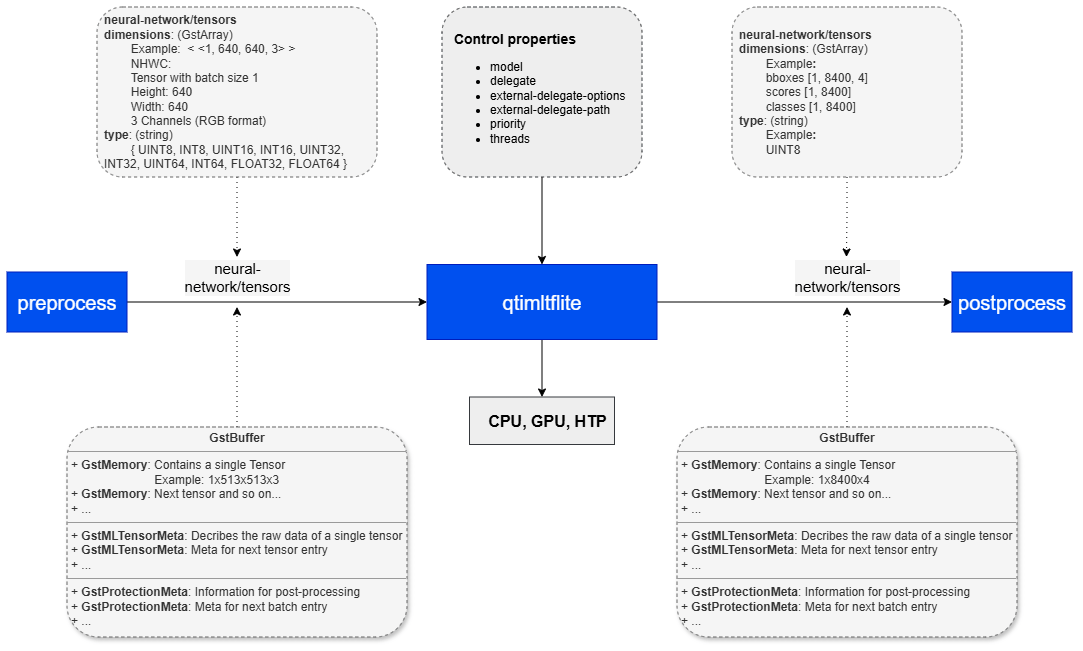
In practice, qtimltflite serves as the inference stage in the pipeline, while tensor preparation and result interpretation are handled externally.

Example Pipeline

1

Download Required Files

FileDownloadSave as
YOLOX W8A8 modelQualcomm AI Hub — YOLOXyolox_w8a8.tflite
Detection labelsyolov8.jsonyolov8.json
Sample videoInput videoDraw_1080p_180s_30FPS.mp4
If any downloaded file is a .zip archive, extract it on your host machine before copying: unzip filename.zip
2

Copy files to device

# Replace $HOME to the appropriate device path before running the commands.
# For QLI:    /root
# For Ubuntu: /home/ubuntu
# Modify this based on your platform and ensure files are copied to the correct location on the device.
# Run from your host machine — replace <user> and <device-ip>

ssh <user>@<device-ip> "mkdir -p $HOME/{models,labels,media,media/output}"
scp yolox_w8a8.tflite           <user>@<device-ip>:$HOME/models/
scp yolov8.json                  <user>@<device-ip>:$HOME/labels/
scp Draw_1080p_180s_30FPS.mp4    <user>@<device-ip>:$HOME/media/
3

Connect to device

# Run from your host machine — replace <user> and <device-ip>
ssh <user>@<device-ip>
4

Set environment variables

Run below command on your device
export MODEL_NAME=yolox_w8a8.tflite
export LABELS_NAME=yolov8.json
export SRC_VIDEO_NAME=Draw_1080p_180s_30FPS.mp4
5

Run the pipeline

gst-launch-1.0 -e --gst-debug=2 \
filesrc location=$HOME/media/$SRC_VIDEO_NAME ! qtdemux ! h264parse ! \
v4l2h264dec capture-io-mode=4 output-io-mode=4 ! video/x-raw,format=NV12 ! queue ! \
tee name=t ! qtimetamux name=obj_mux ! qtivoverlay ! waylandsink fullscreen=true sync=true \
t. ! queue ! qtimlvconverter ! queue ! \
qtimltflite model=$HOME/models/$MODEL_NAME delegate=external external-delegate-path=libQnnTFLiteDelegate.so external-delegate-options="QNNExternalDelegate,backend_type=htp,log_level=(string)1;" ! queue ! \
qtimlpostprocess module=yolov8 labels=$HOME/labels/$LABELS_NAME ! text/x-raw ! queue ! obj_mux.

Hierarchy

GObject
   GstObject
      GstElement
         GstBaseTransform
            qtimltflite

Pad Templates

sink

Capabilities
neural-network/tensorsformat: { INT8, UINT8, INT16, UINT16, INT32, UINT32, INT64, UINT64, FLOAT16, FLOAT32 }
Availability: Always
Direction: sink

src

Capabilities
neural-network/tensorsformat: { INT8, UINT8, INT16, UINT16, INT32, UINT32, INT64, UINT64, FLOAT16, FLOAT32 }
Availability: Always
Direction: source

Element Properties

PropertyDescription
modelPath to the TensorFlow Lite model file. This property is required and must reference a valid .tflite model.

Type: String
Default: NULL
Flags: readable/writable
delegateSelects the execution backend used for inference.

Type: Enum
Default: 0, "none"
Range:
    (0): none - Default TensorFlow Lite CPU execution
    (5): gpu - TensorFlow Lite GPU delegate
    (6): xnnpack - Optimized CPU execution through XNNPACK
    (7): external - External delegate loaded through external-delegate-path and external-delegate-options
Flags: readable/writable
external-delegate-pathAbsolute path to the external delegate shared library. Used only when delegate=external.

Type: String
Default: NULL
Flags: readable/writable
external-delegate-optionsDelegate-specific initialization options passed to the external delegate. Used only when delegate=external.

Type: String
Default: NULL
Flags: readable/writable
prioritySelects the execution preference for supported delegates, typically when there is a trade-off between latency and precision.

Type: Enum
Default: 0, "min-latency"
Range:
    (0): min-latency - Reduce latency at the cost of precision
    (1): max-precision - Increase precision at the cost of higher latency
Flags: readable/writable
threadsNumber of threads assigned to the TensorFlow Lite interpreter. Primarily affects CPU-based execution including XNNPACK.

Type: Unsigned Integer
Default: 1
Range: 1 - 4
Flags: readable/writable

Input and Output Behavior

Input Tensors

qtimltflite exposes a single sink pad, but it supports both single-input and multi-input models. For multi-input models, all required tensors are delivered through the same sink pad as a tensor set. Input tensors must be fully prepared before they reach qtimltflite. Expected tensor layout, shape, data type, and batch size are determined by:
  • the TensorFlow Lite model input signature
  • caps negotiation with upstream elements
Typical upstream elements include: qtimltflite does not modify, reshape, batch, or reinterpret incoming tensors. It passes them to the TensorFlow Lite runtime as received.

Output Tensors

qtimltflite exposes a single source pad and produces output tensors according to the model output signature. The single source pad does not limit the element to a single tensor. Models with multiple output tensors are fully supported, and all outputs are emitted together on the same pad. The element supports:
  • single-output and multi-output models
  • arbitrary tensor ranks, including batch and depth dimensions
  • quantized and floating-point outputs
Output tensors are typically consumed by downstream post-processing elements, which decode model-specific results such as classification scores, detection boxes, segmentation masks, landmarks, or other structured outputs.

Quantization and Dequantization

qtimltflite can optionally dequantize quantized output tensors, such as UINT8 or INT8, into FLOAT32. This conversion uses the quantization parameters stored in the TensorFlow Lite model metadata.

Conditional Output Dequantization

Dequantization is performed only when the downstream path requires FLOAT32 tensors. In practice, this is enabled when downstream caps negotiation indicates that floating-point output is needed. When dequantization is applied, qtimltflite:
  • reads the tensor scale
  • reads the tensor zero_point
  • applies the standard TensorFlow Lite dequantization formula:
output_float = scale × (quantized_value - zero_point)
  • produces FLOAT32 tensors for downstream processing

When Dequantization Is Skipped

Dequantization is not performed when:
  • downstream elements accept only quantized tensor types
  • no downstream element negotiates FLOAT32
  • the model output tensor does not contain valid quantization metadata
In these cases, the output tensor is forwarded in its original quantized representation. This behavior allows the same downstream processing path to support both quantized and floating-point models where applicable, while avoiding unnecessary conversion.

Supported Data Types

qtimltflite supports the tensor data types provided by the TensorFlow Lite runtime and the selected execution backend, subject to caps negotiation with adjacent elements. Commonly used data types include:
  • UINT8
  • INT8
  • INT32
  • FLOAT16
  • FLOAT32
The element does not impose additional data-type restrictions beyond those required by the runtime, the selected delegate, and negotiated pipeline caps.

Batch and Depth Model Support

qtimltflite supports models with batch and multi-dimensional tensor inputs and outputs, including tensors with explicit batch and depth dimensions. Examples include:
  • batched tensors: N × H × W × C
  • multi-dimensional tensors: N × D × H × W × C
The element treats these dimensions transparently and passes tensors to TensorFlow Lite according to the negotiated shape. It does not construct batches, reshape tensors, or reinterpret tensor dimensions internally. Batch construction must be handled by upstream elements such as qtibatch. This behavior keeps inference predictable across single-frame, batched, and higher-dimensional workflows.

Delegates

A TensorFlow Lite delegate defines the execution backend used to run a model. Delegates allow qtimltflite to offload inference from the default TensorFlow Lite CPU interpreter to an optimized backend, such as GPU, an optimized CPU runtime, or NPU. qtimltflite supports multiple delegate options. The delegate is selected through the delegate property and controls how TensorFlow Lite dispatches model operations during inference.

Built-in Delegate Options

none

Runs the model on the default TensorFlow Lite CPU interpreter.
  • Backend: CPU
  • Use case: reference execution, debugging, or systems without acceleration

gpu

Runs supported operations through the TensorFlow Lite GPU delegate.
  • Backend: GPU
  • Use case: floating-point models/workloads that benefit from GPU parallelism

xnnpack

Runs inference through the XNNPACK optimized CPU backend.
  • Backend: Optimized CPU
  • Use case: improved CPU performance for supported floating-point and quantized models

External Delegate Support

External delegate is used to accelerate models on Qualcomm’s NPU. When an external delegate is selected, qtimltflite loads and configures the delegate at runtime using the following properties:
  • external-delegate-path
    • Path to the external delegate shared library.
  • external-delegate-options
    • Delegate-specific initialization options passed to the external delegate.
After initialization, supported model operations are offloaded to the NPU backend implemented by the external delegate.

Runtime Memory Behavior and GAP Handling

qtimltflite operates within the memory model of the TensorFlow Lite runtime. Although the surrounding pipeline may use zero-copy transport for tensor buffers, TensorFlow Lite execution requires input and output tensors to reside in runtime-managed memory.

TensorFlow Lite Memory Model

TensorFlow Lite uses an internal memory arena to allocate:
  • input tensors
  • intermediate activation tensors
  • output tensors

GAP Buffer Handling

qtimltflite is GAP-aware and correctly handles input buffers marked with GST_BUFFER_FLAG_GAP. When a GAP buffer is received, the element skips inference and forwards the buffer downstream. This preserves timing and synchronization while explicitly indicating that no valid inference input is available for that timestamp. GAP buffers commonly appear in conditional AI pipelines, such as cascaded workflows where later inference stages run only when earlier stages produce valid regions of interest.

Usage

Single-Stage AI Inference on Live Camera Stream

This example demonstrates real-time inference on a live camera stream using a single instance of qtimltflite. Inference results are attached to each GstBuffer as MLMeta, allowing downstream elements to access synchronized metadata directly from the frame. An overlay stage then uses this metadata to render annotations such as bounding boxes, labels, or key-points before display or further processing.
1

Download Required Files

FileDownloadSave as
YOLOX W8A8 modelQualcomm AI Hub — YOLOXyolox_w8a8.tflite
Detection labelsyolov8.jsonyolov8.json
If any downloaded file is a .zip archive, extract it on your host machine before copying: unzip filename.zip
2

Copy files to device

# Replace $HOME to the appropriate device path before running the commands.
# For QLI:    /root
# For Ubuntu: /home/ubuntu
# Modify this based on your platform and ensure files are copied to the correct location on the device.
# Run from your host machine — replace <user> and <device-ip>

ssh <user>@<device-ip> "mkdir -p $HOME/{models,labels}"
scp yolox_w8a8.tflite    <user>@<device-ip>:$HOME/models/
scp yolov8.json          <user>@<device-ip>:$HOME/labels/
3

Connect to device

# Run from your host machine — replace <user> and <device-ip>
ssh <user>@<device-ip>
4

Set environment variables

Run below command on your device
export MODEL_NAME=yolox_w8a8.tflite
export LABELS_NAME=yolov8.json
5

Run the pipeline

Run the pipeline
gst-launch-1.0 -e --gst-debug=2 \
qticamsrc name=camsrc ! video/x-raw,format=NV12,width=1920,height=1080,framerate=30/1 ! queue ! \
tee name=t ! qtimetamux name=obj_mux ! qtivoverlay ! waylandsink fullscreen=true sync=true \
t. ! queue ! qtimlvconverter ! queue ! \
qtimltflite model=$HOME/models/$MODEL_NAME delegate=external external-delegate-path=libQnnTFLiteDelegate.so external-delegate-options="QNNExternalDelegate,backend_type=htp,log_level=(string)1;" ! queue ! \
qtimlpostprocess module=yolov8 labels=$HOME/labels/$LABELS_NAME settings="{\"confidence\": 51.0}" ! text/x-raw ! queue ! obj_mux.

Two-Stage Daisy Chain AI Inference on Live Camera Stream

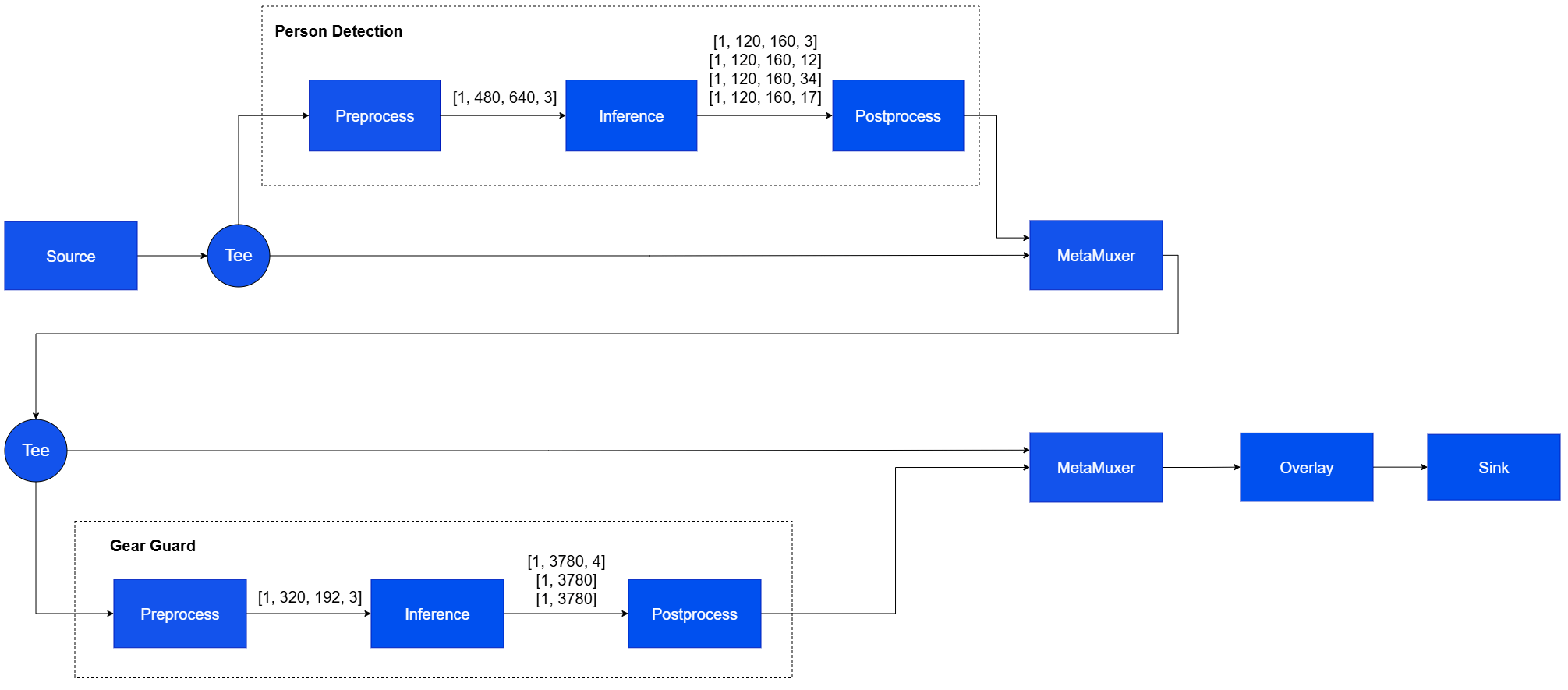
This example demonstrates a two-stage TensorFlow Lite inference workflow using two qtimltflite instances. The first model operates on full video frames after preprocessing by a qtimlvconverter configured for full-frame input. Inference results, such as detected objects, are attached to the corresponding video buffer and propagated downstream. The second model runs once for each object detected by the first stage. A second qtimlvconverter, configured for ROI-based processing, crops each detected region from the input frame and prepares it as input for the second qtimltflite instance.
1

Download Required Files

FileDownloadSave as
Detection model (YOLOX)Qualcomm AI Hub — YOLOXyolox_w8a8.tflite
Detection labelsyolov8.jsonyolov8.json
Classification model (InceptionV3)Qualcomm AI Hub — InceptionV3inception_v3_w8a8.tflite
Classification labelsmobilenet.jsonmobilenet.json
If any downloaded file is a .zip archive, extract it on your host machine before copying: unzip filename.zip
2

Copy files to device

# Run from your host machine — replace <user> and <device-ip>
ssh <user>@<device-ip> "mkdir -p $HOME/{models,labels}"
scp yolox_w8a8.tflite            <user>@<device-ip>:$HOME/models/
scp yolov8.json                  <user>@<device-ip>:$HOME/labels/
scp inception_v3_w8a8.tflite     <user>@<device-ip>:$HOME/models/
scp mobilenet.json               <user>@<device-ip>:$HOME/labels/
3

Connect to device

# Run from your host machine — replace <user> and <device-ip>
ssh <user>@<device-ip>
4

Set environment variables

Run below command on your device
export MODEL_NAME_1=yolox_w8a8.tflite
export LABELS_NAME_1=yolov8.json
export MODEL_NAME_2=inception_v3_w8a8.tflite
export LABELS_NAME_2=mobilenet.json
5

Run the pipeline

Run the pipeline
gst-launch-1.0 -e --gst-debug=2 \
  qtimlvconverter name=stage_01_preproc \
  qtimltflite name=stage_01_inference delegate=external external-delegate-path=libQnnTFLiteDelegate.so \
  external-delegate-options="QNNExternalDelegate,backend_type=htp,log_level=(string)1;" \
  model=$HOME/models/$MODEL_NAME_1 \
  qtimlpostprocess name=stage_01_postproc module=yolov8 labels=$HOME/labels/$LABELS_NAME_1 \
  settings="{\"confidence\": 51.0}" \
  qtimetamux name=metamux_1 \
  qtivoverlay name=main_overlay \
  qtimlvconverter name=stage_02_preproc \
  qtimltflite name=stage_02_inference delegate=external external-delegate-path=libQnnTFLiteDelegate.so \
  external-delegate-options="QNNExternalDelegate,backend_type=htp,log_level=(string)1;" \
  model=$HOME/models/$MODEL_NAME_2 \
  qtimlpostprocess name=stage_02_postproc module=mobilenet labels=$HOME/labels/$LABELS_NAME_2 \
  settings="{\"confidence\": 51.0}" \
  qtimetamux name=metamux_2 \
  qtivoverlay name=cls_overlay \
  qticamsrc name=camsrc ! video/x-raw,format=NV12,width=1920,height=1080,framerate=30/1 ! queue ! \
  tee name=t_split_1 \
  t_split_1. ! queue ! metamux_1. \
  t_split_1. ! queue ! stage_01_preproc. stage_01_preproc. ! queue ! stage_01_inference. stage_01_inference. ! queue ! \
  stage_01_postproc. stage_01_postproc. ! text/x-raw ! queue ! metamux_1. \
  metamux_1. ! queue ! tee name=t_split_2 \
  t_split_2. ! queue ! metamux_2. \
  t_split_2. ! queue ! stage_02_preproc. stage_02_preproc. ! queue ! stage_02_inference. stage_02_inference. ! queue ! \
  stage_02_postproc. stage_02_postproc. ! text/x-raw ! queue ! metamux_2. \
  metamux_2. ! queue ! cls_overlay. cls_overlay. ! queue ! waylandsink sync=true fullscreen=true

Four-Stage Daisy Chain AI Inference on Live Camera Stream

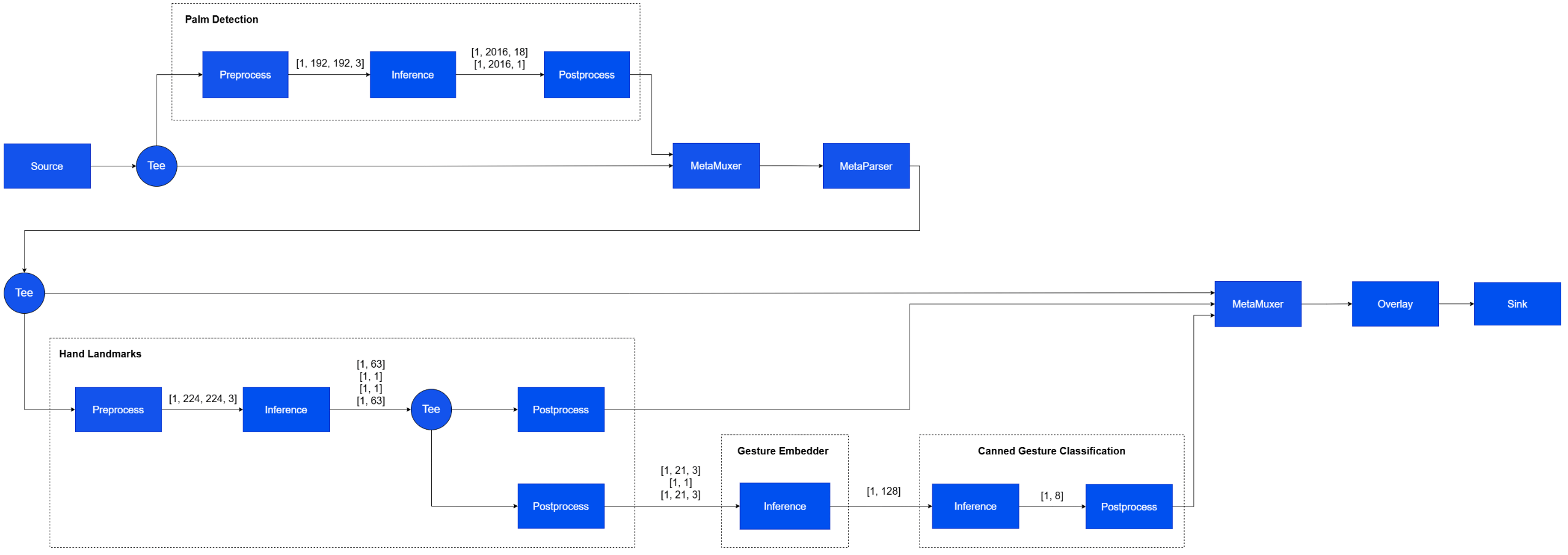
The example demonstrates a multi-stage inference workflow for live Hand-Gesture recognition use case built with four TensorFlow Lite models executed through four qtimltflite instances.
  • Stage 1 performs full-frame palm detection. The input video frame is preprocessed, passed through inference, and post-processed to generate metadata describing the detected palm.
  • Stage 2 performs per-ROI hand landmark inference. Regions detected in the first stage are cropped and batched for processing. Two post-processing paths are used: one generates visualization metadata, while the other reformats the output tensors for the next stage.
  • Stage 3 chains two models in tensor-only mode, without additional preprocessing or post-processing. The first model consumes multiple tensors produced by the previous stage, and its output is passed directly to the second model.
  • Stage 4 performs final gesture classification and converts the model output into metadata for downstream use.
1

Download Required Files

Download the gesture recognizer models from Google MediaPipe:
# Download the gesture recognizer task
wget https://storage.googleapis.com/mediapipe-models/gesture_recognizer/gesture_recognizer/float16/latest/gesture_recognizer.task 

# Extract the .task file
unzip gesture_recognizer.task
# This gives you two more task files: hand_landmarker.task and hand_gesture_recognizer.task

# Extract hand_landmarker.task
unzip hand_landmarker.task
# This gives you hand_detector.tflite and hand_landmarks_detector.tflite

# Extract hand_gesture_recognizer.task
unzip hand_gesture_recognizer.task
# This gives you gesture_embedder.tflite and canned_gesture_classifier.tflite
These are FLOAT precision models.
FileDownloadSave as
Palm detection modelSee download steps abovehand_detector.tflite
Palm detection labelspalmd_labels.jsonpalmd_labels.json
Palm detection settingspalmd_settings.jsonpalmd_settings.json
Hand landmark modelSee download steps abovehand_landmarks_detector.tflite
Hand landmark labelshlandmark_labels.jsonhlandmark_labels.json
Hand landmark settingshlandmark_settings.jsonhlandmark_settings.json
Gesture embedder modelSee download steps abovegesture_embedder.tflite
Gesture classifier modelSee download steps abovecanned_gesture_classifier.tflite
Gesture labelsgesture_labels.jsongesture_labels.json
2

Copy files to device

# Run from your host machine — replace <user> and <device-ip>
ssh <user>@<device-ip> "mkdir -p $HOME/{models,labels}"
scp hand_detector.tflite               <user>@<device-ip>:$HOME/models/
scp palmd_labels.json                  <user>@<device-ip>:$HOME/labels/
scp palmd_settings.json                <user>@<device-ip>:$HOME/labels/
scp hand_landmarks_detector.tflite     <user>@<device-ip>:$HOME/models/
scp hlandmark_labels.json              <user>@<device-ip>:$HOME/labels/
scp hlandmark_settings.json            <user>@<device-ip>:$HOME/labels/
scp gesture_embedder.tflite            <user>@<device-ip>:$HOME/models/
scp canned_gesture_classifier.tflite   <user>@<device-ip>:$HOME/models/
scp gesture_labels.json                <user>@<device-ip>:$HOME/labels/
3

Connect to device

# Run from your host machine — replace <user> and <device-ip>
ssh <user>@<device-ip>
4

Set environment variables

Run below command on your device
export MODEL_NAME_1=hand_detector.tflite
export LABELS_NAME_1=palmd_labels.json
export LABELS_NAME_2=palmd_settings.json
export MODEL_NAME_2=hand_landmarks_detector.tflite
export LABELS_NAME_3=hlandmark_labels.json
export LABELS_NAME_4=hlandmark_settings.json
export MODEL_NAME_3=gesture_embedder.tflite
export MODEL_NAME_4=canned_gesture_classifier.tflite
export LABELS_NAME_5=gesture_labels.json
5

Run the pipeline

Run the pipeline
gst-launch-1.0 -e --gst-debug=2 \
qtimlvconverter name=stage_01_preproc \
qtimltflite name=stage_01_inference delegate=gpu model=$HOME/models/$MODEL_NAME_1 \
qtimlpostprocess name=stage_01_postproc results=1 module=palmd labels=$HOME/labels/$LABELS_NAME_1 settings=$HOME/labels/$LABELS_NAME_2 \
qtimlvconverter name=stage_02_preproc mode=roi-batch-non-cumulative \
qtimltflite name=stage_02_inference delegate=gpu model=$HOME/models/$MODEL_NAME_2 \
qtimlpostprocess name=stage_02_1_postproc results=6 module=hlandmark labels=/$HOME/labels/$LABELS_NAME_3 settings=$HOME/labels/$LABELS_NAME_4 \
qtimlpostprocess name=stage_02_2_postproc results=6 module=tensor \
qtimltflite name=stage_03_1_inference delegate=gpu model=$HOME/models/$MODEL_NAME_3 \
qtimltflite name=stage_03_2_inference delegate=gpu model=$HOME/models/$MODEL_NAME_4 \
qtimlpostprocess name=stage_03_postproc results=8 module=mobilenet labels=$HOME/labels/$LABELS_NAME_5 \
qticamsrc ! video/x-raw,format=NV12,width=1920,height=1080,framerate=30/1 ! queue ! tee name=t_split_1 \
t_split_1. ! queue ! qtimetamux name=metamux_1 ! queue ! qtimetatransform module=roi-palmd ! queue ! tee name=t_split_2 \
t_split_1. ! queue ! stage_01_preproc. stage_01_preproc. ! queue ! stage_01_inference. stage_01_inference. ! queue ! stage_01_postproc. stage_01_postproc. ! text/x-raw ! queue ! metamux_1. \
t_split_2. ! queue ! qtimetamux name=metamux_2 ! queue ! qtivoverlay ! waylandsink fullscreen=true sync=false \
t_split_2. ! queue ! stage_02_preproc. stage_02_preproc. ! queue ! stage_02_inference. stage_02_inference. ! queue ! tee name=t_split_3 \
t_split_3. ! queue ! stage_02_1_postproc. stage_02_1_postproc. ! text/x-raw ! metamux_2. \
t_split_3. ! queue ! stage_02_2_postproc. stage_02_2_postproc. ! queue ! stage_03_1_inference. stage_03_1_inference. ! stage_03_2_inference. stage_03_2_inference. ! stage_03_postproc. stage_03_postproc. ! text/x-raw ! metamux_2.
