
- QCS6490/QCS5430
- IQ-9075
- IQ-8275
- IQ-615
- IQ-X7181
- IQ-X5121
- CQ-2390
- IQ-X10
APSS is a set of CPUs organized into clusters. All CPU cores in a cluster operate at a similar frequency. Each CPU core in a cluster has a dedicated L1 and L2 cache.The CPU subsystem consists of three clusters and L3 cache as follows: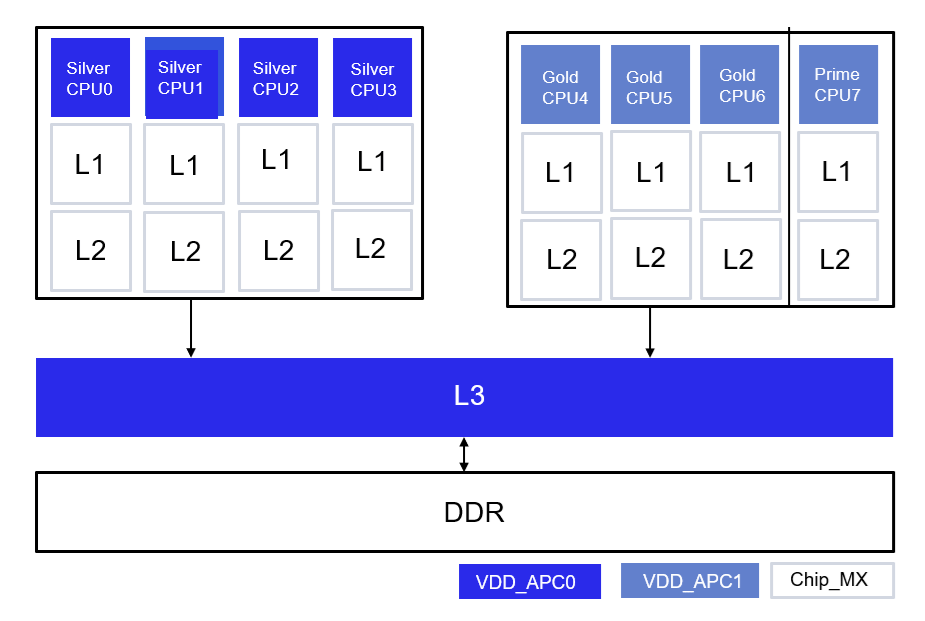
- Qualcomm® Kryo™ CPU Prime cluster, which has a performance CPU core
- Kryo Gold cluster, which has CPU cores with balanced power and performance
- Kryo Silver cluster, which has low power CPU cores for lightweight applications
- Common L3 cache
The CPU subsystem operates on two power domains, each supplied by a dedicated switched mode power supply (SMPS) rail. The following are the supported power domains:
Note To know more about CPU core arrangement, see QCS6490 Data Sheet and QCS5430 Data Sheet.
Table : Power domains and their descriptions Power domains Description VDD_APC0Power domain for the Silver cluster CPU cores and L3 cache digital circuit VDD_APC1Power domain for the Gold and Prime clusters CPU cores Chip_MXPower domain for the L1, L2, and L3 cache memories
The CPU subsystem consists of two clusters with a dedicated L3 cache for each cluster. Each CPU core in a cluster has a dedicated L1 and L2 cache. All CPU cores in a cluster operate at a similar frequency.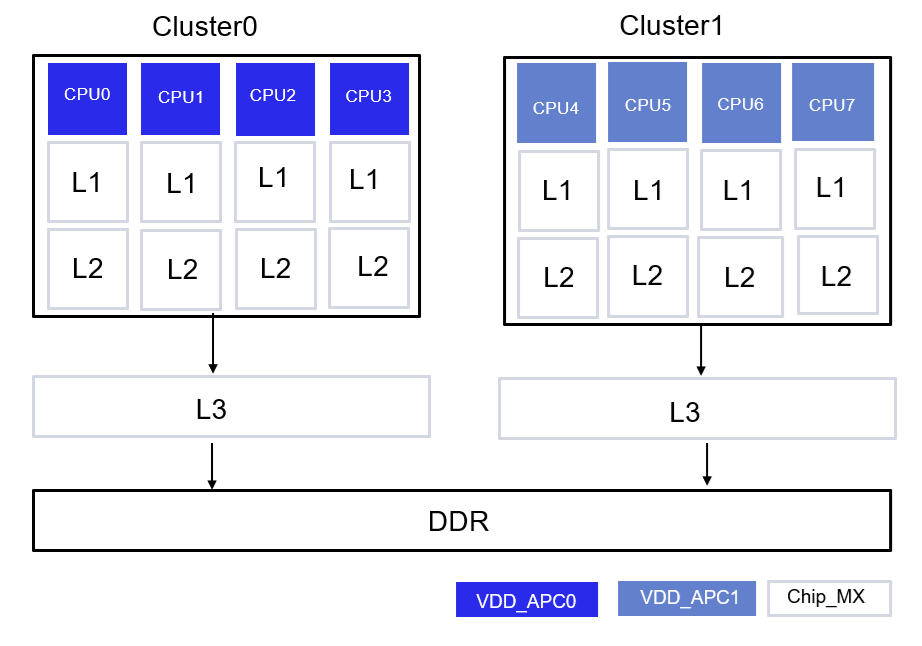
To know more about CPU core arrangement, see IQ-9075 Data Sheet.
Table : Power domains and their descriptionsThe CPU subsystem operates on two power domains, each supplied by a dedicated SMPS rail. The following are the supported power domains:
| Power domains | Description |
|---|---|
VDD_APC0 | Power domain for Cluster0 CPU cores and L3 cache digital circuit |
VDD_APC1 | Power domain for Cluster1 CPU cores and L3 cache digital circuit |
Chip_MX | Power domain for the L1, L2, and L3 cache memories |
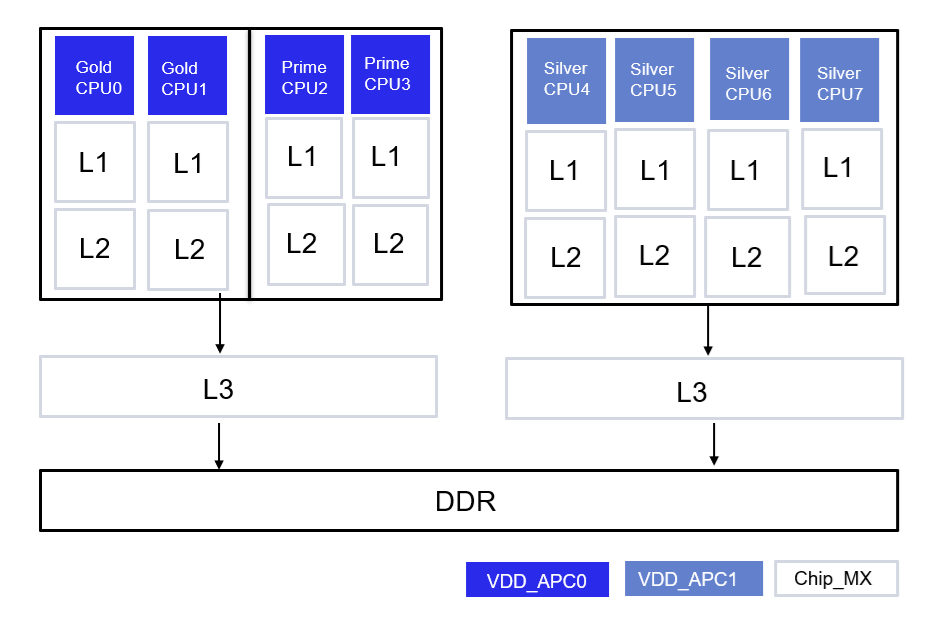
APSS is a set of CPUs organized into clusters. All CPU cores in a cluster operate at a similar frequency. Each CPU core in a cluster has a dedicated L1 and L2 cache. The CPU subsystem consists of three clusters and L3 cache as follows:
- Kryo Prime cluster with performance CPU cores
- Kryo Gold cluster, which has CPU cores with balanced power and performance
- Kryo Silver cluster, which has low power CPU cores for lightweight applications
- Silver cluster has a dedicated L3 cache
- Gold and Prime clusters share a dedicated L3 cache
To know more about CPU core arrangement, see IQ-8275 Data Sheet.
Table : Power domains and their descriptions Power domains Description VDD_APC0Power domain for the Gold and Prime cluster CPU cores and L3 cache digital circuit VDD_APC1Power domain for the Silver cluster CPU cores and L3 cache digital circuit Chip_MXPower domain for the L1, L2, and L3 cache memories
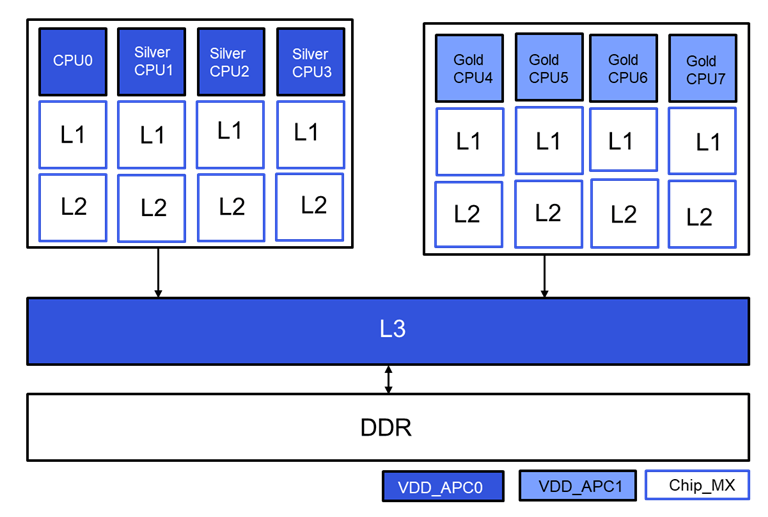
APSS is a set of CPUs organized into clusters. All CPU cores in a cluster operate at a similar frequency. Each CPU core in a cluster has a dedicated L1 and L2 cache.The CPU subsystem consists of two clusters and L3 cache as follows:
- Qualcomm® Kryo™ Gold cluster, which has CPU cores with balanced power and performance
- Kryo Silver cluster, which has low power CPU cores for lightweight applications
- Common L3 cache
To know more about CPU core arrangement, see IQ-615 Data Sheet.Figure : IQ-615 APSS CPU subsystem architecture The CPU subsystem operates on two power domains, each supplied by a dedicated SMPS rail. The following are the supported power domains:
Table : Power domains and their descriptions Power domains Description VDD_APC0Power domain for the Silver cluster CPU cores and L3 cache digital circuit VDD_APC1Power domain for the Gold cluster CPU cores Chip_MXPower domain for the L1, L2, and L3 cache memories
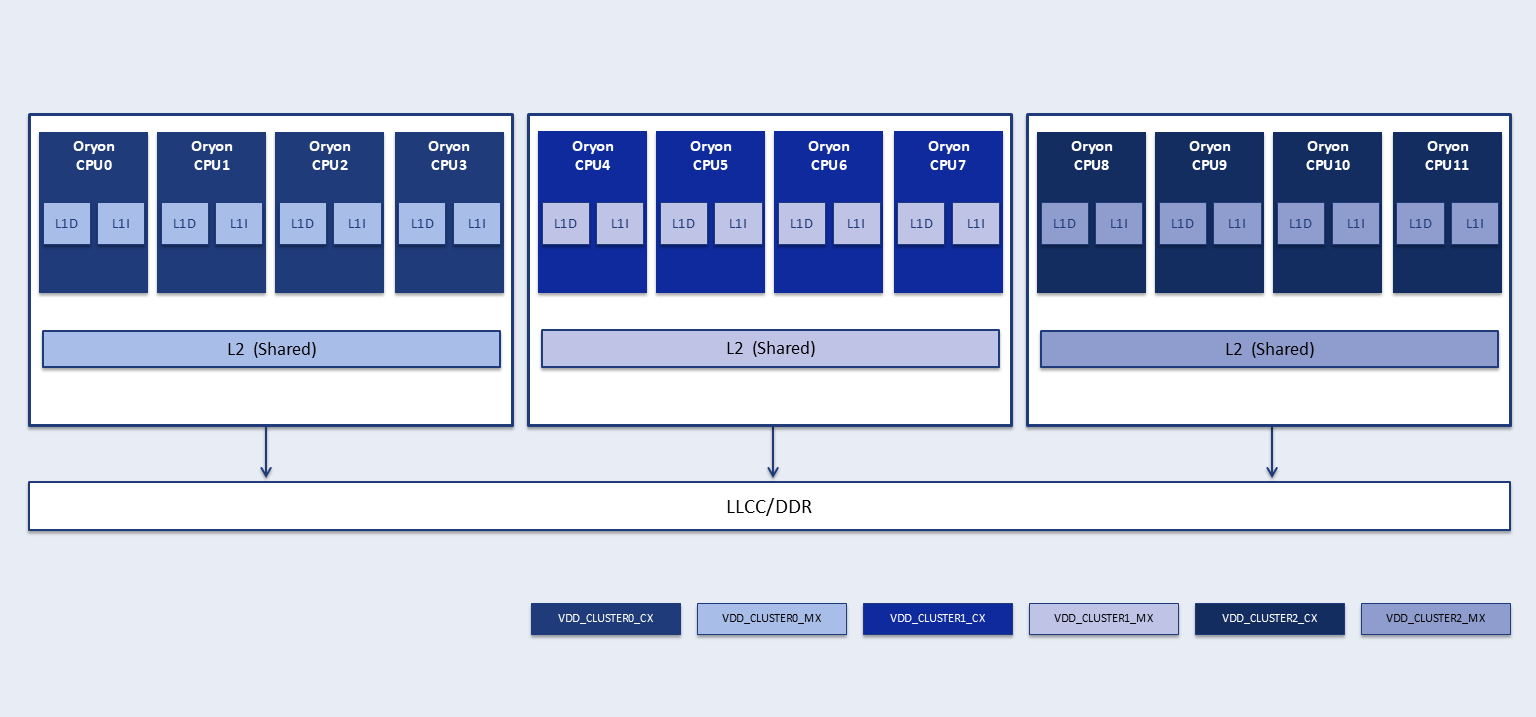
APSS is a set of CPUs organized into clusters. All CPU cores in a cluster operate at a similar frequency. Each CPU core in a cluster has a dedicated L1 cache and each cluster has a dedicated L2 cache.The CPU subsystem is organized into three clusters, each with its own dedicated L2 cache:
- NCC Efficiency Cluster 0, which has 4 Qualcomm Oryon™ CPU efficiency cores for lightweight applications
- NCC Performance Cluster 1, which has 4 Oryon Performance CPU cores for balanced power and performance workloads
- NCC Performance Cluster 2, which has 4 Oryon Performance CPU cores for balanced power and performance workloads
- Shared L2 cache per each cluster
Figure : IQ-X7181 APSS CPU subsystem architecture The CPU subsystem uses separate logic and memory power domains for each cluster. Each domain is powered by its own dedicated SMPS rail. Following are the supported power domains:
Table : Power domains and their descriptions Power domains Description VDD_CLUSTER0_CXLogic power domain for the NCC Efficiency cluster 0 CPU cores VDD_CLUSTER0_MXMemory power domain for the NCC Efficiency cluster 0 L1 and L2 caches VDD_CLUSTER1_CXLogic power domain for the NCC Performance cluster 1 CPU cores VDD_CLUSTER1_MXMemory power domain for the NCC Performance cluster 1 L1 and L2 caches VDD_CLUSTER2_CXLogic power domain for the NCC Performance cluster 2 CPU cores VDD_CLUSTER2_MXMemory power domain for the NCC Performance cluster 2 L1 and L2 caches
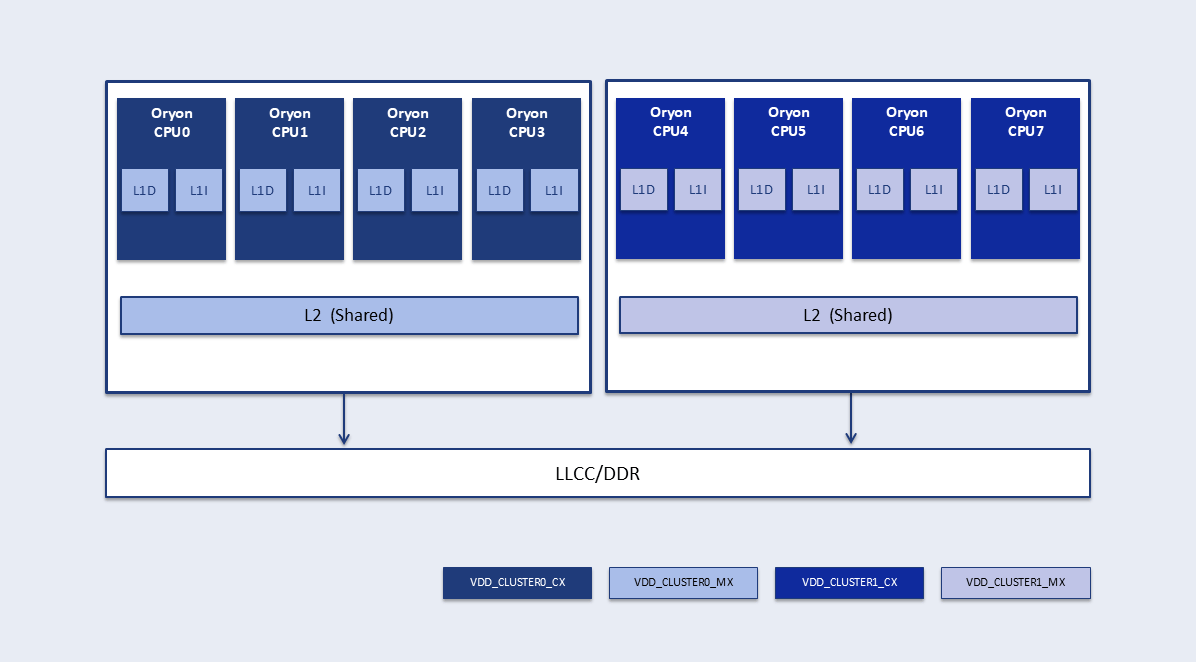
APSS is a set of CPUs organized into clusters. All CPU cores in a cluster operate at a similar frequency. Each CPU core in a cluster has a dedicated L1 cache and each cluster has a dedicated L2 cache.The CPU subsystem consists of two clusters and a dedicated L2 cache as follows:
- NCC Performance Cluster 0, which has 4 Qualcomm Oryon Performance CPU cores for balanced power and performance workloads
- NCC Performance Cluster 1, which has 4 Qualcomm Oryon Performance CPU cores for balanced power and performance workloads
- Shared L2 cache per each cluster
Figure : IQ-X5121 APSS CPU subsystem architecture The CPU subsystem operates on dedicated logic and memory power domains for each cluster. Each domain is powered by its own dedicated SMPS rail. Following are the supported power domains:
Table : Power domains and their descriptions Power domains Description VDD_CLUSTER0_CXLogic power domain for the NCC Performance cluster 0 CPU cores VDD_CLUSTER0_MXMemory power domain for the NCC Performance cluster 0 L1 and L2 caches VDD_CLUSTER1_CXLogic power domain for the NCC Performance cluster 1 CPU cores VDD_CLUSTER1_MXMemory power domain for the NCC Performance cluster 1 L1 and L2 caches
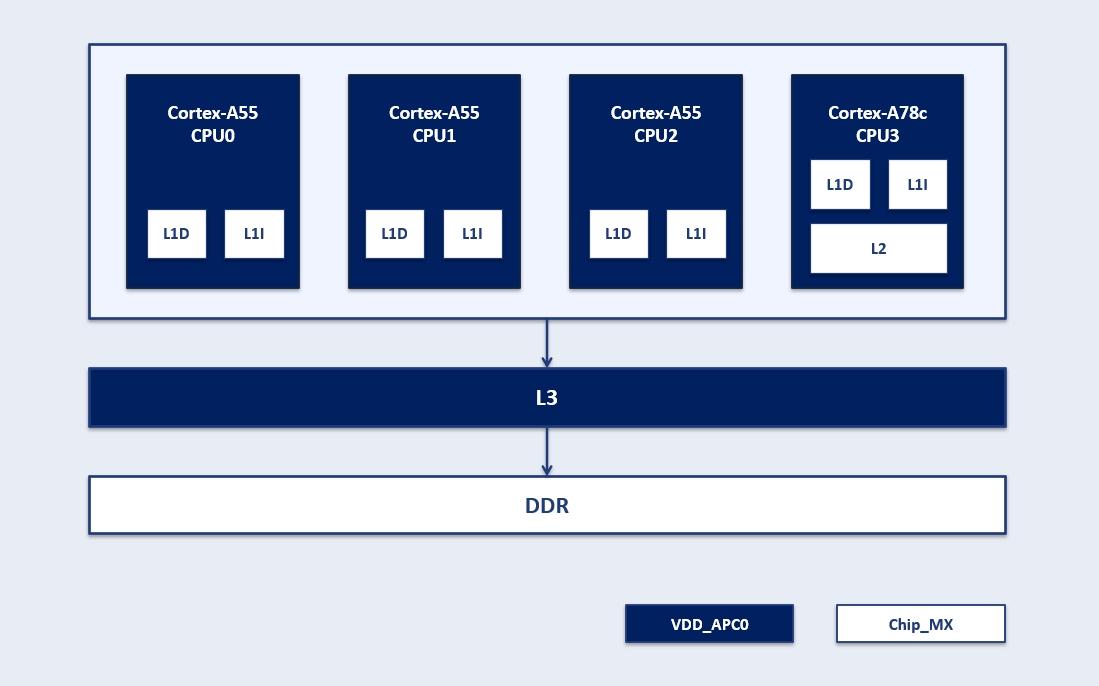
APSS is a set of CPUs organized into clusters. All CPU cores in a cluster operate at a similar frequency.The CPU subsystem consists of a single cluster and a common L3 cache:
- 3 Cortex-A55 low power CPU cores with dedicated L1 cache for lightweight applications
- 1 Cortex-A78c CPU core with dedicated L1 and L2 caches for balanced power and performance workloads
- Common L3 cache
Figure : CQ-2390 APSS CPU subsystem architecture The CPU subsystem operates on one power domain supplied by a dedicated SMPS rail. Following are the supported power domains:
Table : Power domains and their descriptions Power domains Description VDD_APC0Power domain for the Cortex-A55 and Cortex-A78c CPU cores and L3 cache digital circuit Chip_MXPower domain for the L1, L2, and L3 cache memories
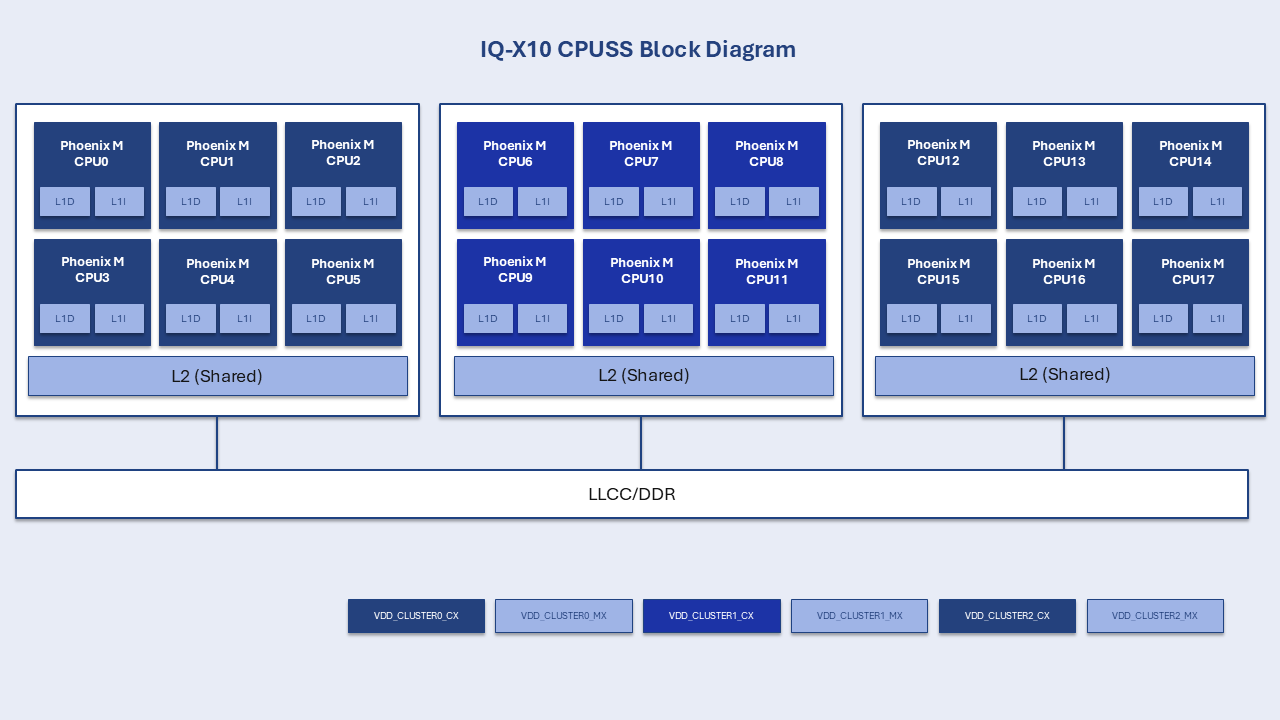
APSS is a set of CPUs organized into clusters. All CPU cores in a cluster operate at a similar frequency. Each CPU core in a cluster has a dedicated L1 cache and each cluster has a dedicated L2 cache.The CPU subsystem is organized into three clusters, each with its own dedicated L2 cache:
- NCC Cluster 0, which has 6 Qualcomm Phoenix M CPU cores for balanced power and performance workloads
- NCC Cluster 1, which has 6 Phoenix M CPU cores for balanced power and performance workloads
- NCC Cluster 2, which has 6 Phoenix M CPU cores for balanced power and performance workloads
- Shared L2 cache per each cluster
Figure : IQ-X10 APSS CPU subsystem architecture The CPU subsystem uses separate logic and memory power domains for each cluster. Each domain is powered by its own dedicated SMPS rail. Following are the supported power domains:
Table : Power domains and their descriptions Power domains Description VDD_CLUSTER0_CXLogic power domain for the NCC Cluster 0 CPU cores VDD_CLUSTER0_MXMemory power domain for the NCC Cluster 0 L1 and L2 caches VDD_CLUSTER1_CXLogic power domain for the NCC Cluster 1 CPU cores VDD_CLUSTER1_MXMemory power domain for the NCC Cluster 1 L1 and L2 caches VDD_CLUSTER2_CXLogic power domain for the NCC Cluster 2 CPU cores VDD_CLUSTER2_MXMemory power domain for the NCC Cluster 2 L1 and L2 caches