

- Serves as a three-dimensional (3D) graphics accelerator with 64‑bit addressing.
- Incorporates the graphics memory (GMEM) as a dedicated memory for the graphics subsystem and facilitates Fast Z, color, and stencil rendering.
- Supports Qualcomm® Universal Bandwidth Compression, enhancing the overall performance.
Graphics subsystem architecture
The graphics architecture consists of Qualcomm and open-source components, as shown in the following figure.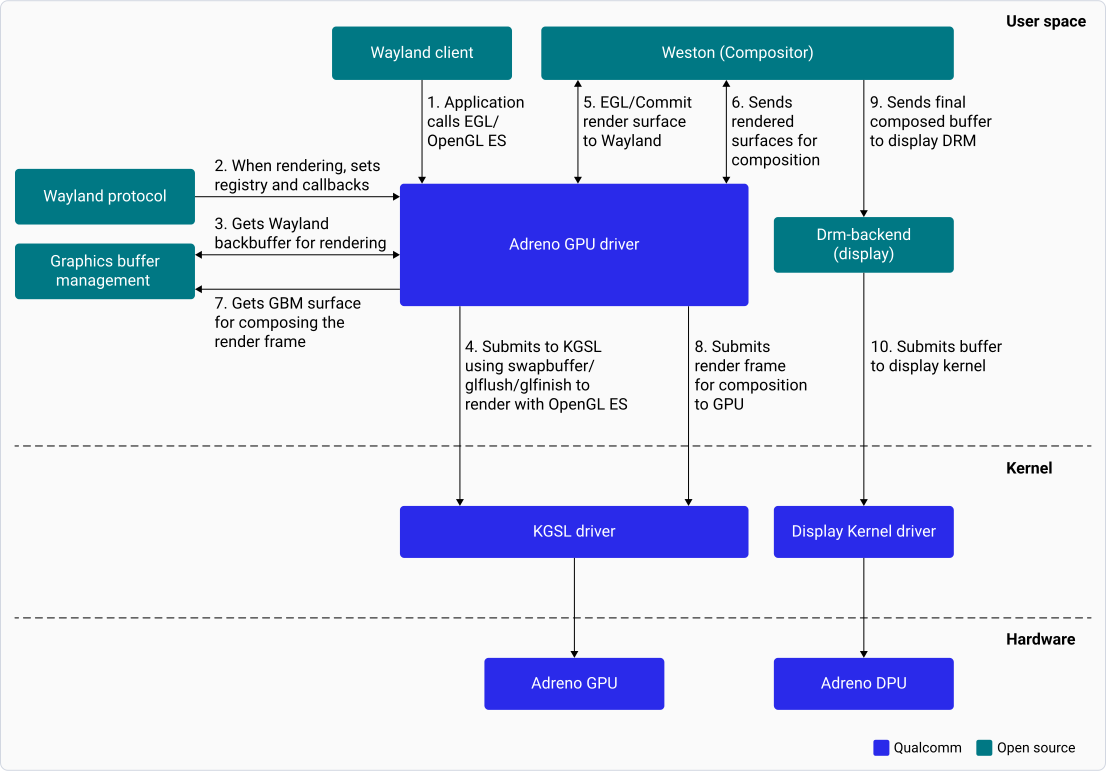
Figure: Graphics subsystem architecture
- Wayland client application initiates rendering through EGL/OpenGL ES.
- Wayland protocol sets the registry and callbacks for rendering.
- Graphics buffer management gets the Wayland backbuffer for rendering.
- Adreno GPU driver submits the rendering commands to Kernel Graphics Support Layer (KGSL) using swapbuffer, glflush, or glfinish with OpenGL.
- Weston compositor sends the rendered surfaces for composition to Adreno GPU driver.
- Acquires a GBM surface for composing the rendered frame.
- Adreno GPU driver submits the rendered frame.
- Weston compositor sends the final composed buffer to display through DRM.
- DRM submits the buffer at the back-end to the display kernel driver to show on the screen.
Kernel Graphics Support Layer (KGSL) KGSL serves as the kernel-mode driver for the Adreno GPU. The primary function of the KGSL driver is to submit commands generated by the Adreno user-mode driver to the Adreno GPU for processing. Additionally, the KGSL driver communicates with the GMU to ensure proper state management. The following tables list the supported GPU libraries and KGSL driver information. Note The GPU libraries table is applicable only to overlay or
qcom‑multimedia‑proprietary‑image.
Table: GPU libraries
Table: KGSL driver