

simulation_sample_pick_and_place to demonstrate autonomous pick-and-place operations using MoveIt2 for motion planning and Gazebo for physics simulation.
NoteFor more information, see simulation_sample_pick_and_place on GitHub.
Figure: Sample effects of simulation_sample_pick_and_place
Pipeline flow for simulation_sample_pick_and_place
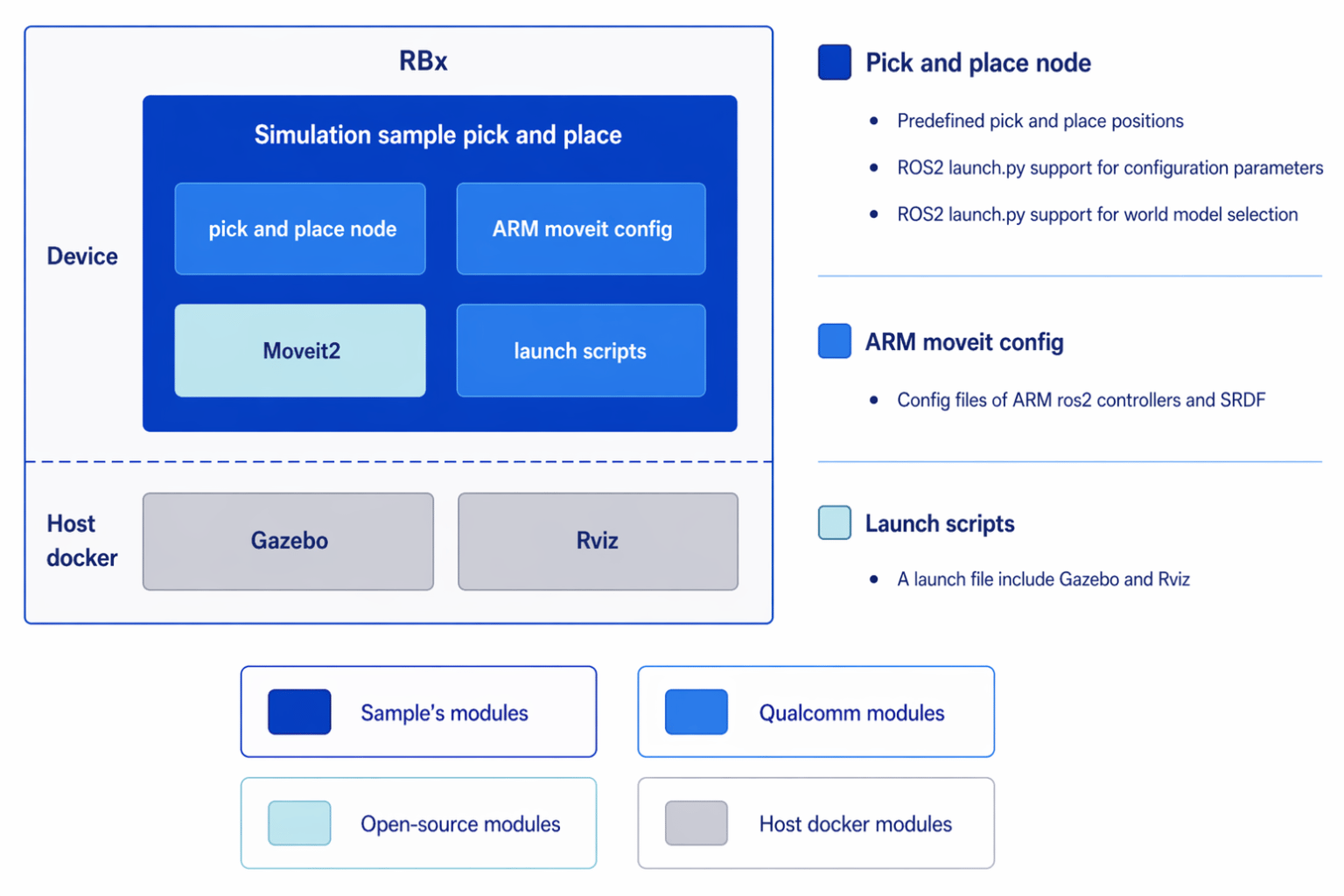
ROS nodes used in the simulation_sample_pick_and_place pipeline
ROS topics used in the simulation_sample_pick_and_place pipeline
| ROS Topics | Type | Description |
|---|---|---|
/joint_states | sensor_msgs/msg/JointState | Real-time data for all robot joints control information. |
/hand_controller/controller_state | control_msgs.msg.ControllerState | Current state and status information of the gripper controller. |
/rm_group_controller/controller_state | control_msgs.msg.ControllerState | Current state and status information of the robotic arm controller. |
/robot_description | std_msgs.msg.String | URDF robot description in XML format for robot modeling and visualization. |
/robot_description_semantic | std_msgs.msg.String | SRDF semantic robot description for MoveIt planning and configuration. |
Prerequisites
Try me
Try me
You have completed the following settings in Set up the environment for running sample applications.
- Set up the device
- Set up the host docker
Set up the simulation environment
1
Build the simulation environment on your host computer
Complete the following to build the Qualcomm robotic simulation environment according to the README of QRB ROS Simulation. Ensure that the device and the host are on the same local network and can communicate with each other through ROS communication.
- Set up development environment on Ubuntu24.04 host or Docker.
- Build from source.
2
Launch the Gazebo simulation environment
Run the
qrb ros simulation on the host. Open a terminal and run the following commands to launch the Gazebo simulation environment:SSH Session
3
Launch the controller manager
Select the
Play button in Gazebo to start the simulation, and then open another terminal and run the following commands to launch the controller manager:SSH Session
Run out-of-the-box simulation_sample_pick_and_place
Try me
Try me
1
Launch the moveit ROS move group
On the development kit, open a terminal and run the following commands:If the ROS node is launched successfully, the log starting from
SSH Session
[move_group-1] You can start planning now! appears.2
Launch the pick-and-place sample application
Open another terminal and run the following commands:
SSH Session
Build and run simulation_sample_pick_and_place
Try me
Try me
Note
<qir_version>: Version of the QIR SDK, see QIR SDK 2.0 Release Notes.<qir_decompressed_path>: The path where you decompress the QIR SDK.
1
Build and package on the host computer
- Build the sample application project.
SSH Session
- Package and push the sample application to the device.
SSH Session
2
Install and run on the development kit
- Install the sample application.
SSH Session
- Run the sample application with the steps in Run out-of-the-box simulation_sample_pick_and_place.