

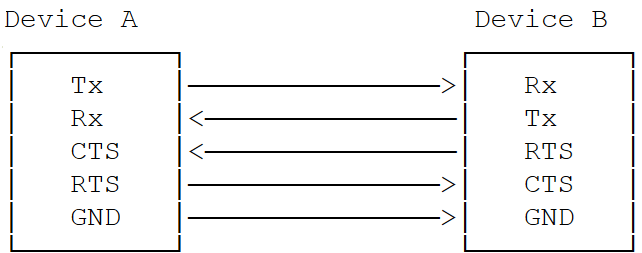
UART (Universal Asynchronous Receiver-Transmitter) transmits data asynchronously using start and stop bits instead of a clock signal. The receiving UART reads bits at a specific frequency known as the baud rate.

Key Parameters

  • Baud rate — Communication speed (bits per second)
  • Start/Stop bits — Frame delimiters
  • Parity bit — Optional error checking
  • Data bits — 5–9 bits per frame
  • Flow control — Hardware handshaking via CTS/RTS

Transfer Modes by Subsystem

SubsystemTransfer ModeBaud RatesNotes
LinuxFIFO, CPU DMA300 bps – 4 MbpsDMA ideal for Bluetooth modules
Boot (UEFI)FIFO onlyUp to 1152005–8 bits per character
aDSPFIFO only115200, 230400, 460800, 921600, 1M, 3M, 6M5–8 bits per character

Interface Components

Device Tree Sources

PlatformFile
Dragonwing IQ-9075arch/arm64/boot/dts/qcom/lemans.dtsi

APIs

SubsystemHeader
Linuxinclude/linux/tty.h
BootQcomPkg/Include/HSUart.h
aDSPadsp_proc/core/api/buses/uart.h

Software Configuration

Linux Device Tree Example

4-wire UART (with flow control):
uart7: serial@99c000 {
    compatible = "qcom,geni-uart";
    reg = <0 0x0099c000 0 0x4000>;
    clocks = <&gcc GCC_QUPV3_WRAP0_S7_CLK>;
    clock-names = "se";
    pinctrl-names = "default";
    pinctrl-0 = <&qup_uart7_cts>, <&qup_uart7_rts>,
                <&qup_uart7_tx>, <&qup_uart7_rx>;
    interrupts = <GIC_SPI 608 IRQ_TYPE_LEVEL_HIGH>;
    power-domains = <&rpmhpd SC7280_CX>;
    interconnects = <&clk_virt MASTER_QUP_CORE_0 0 &clk_virt SLAVE_QUP_CORE_0 0>,
                    <&gem_noc MASTER_APPSS_PROC 0 &cnoc2 SLAVE_QUP_0 0>;
    interconnect-names = "qup-core", "qup-config";
    status = "disabled";
};
GPIO pinctrl:
qup_uart7_cts: qup-uart7-cts-state { pins = "gpio28"; function = "qup07"; };
qup_uart7_rts: qup-uart7-rts-state { pins = "gpio29"; function = "qup07"; };
qup_uart7_tx:  qup-uart7-tx-state  { pins = "gpio30"; function = "qup07"; };
qup_uart7_rx:  qup-uart7-rx-state  { pins = "gpio31"; function = "qup07"; };
QUPAC access control:
// 4-wire HS UART
{ QUPV3_0_SE7, QUPV3_PROTOCOL_UART_4W, QUPV3_MODE_FIFO, AC_HLOS, TRUE, TRUE, FALSE }

// 2-wire UART (no flow control)
{ QUPV3_0_SE5, QUPV3_PROTOCOL_UART_2W, QUPV3_MODE_FIFO, AC_HLOS, TRUE, FALSE, FALSE }

Kernel Configuration

Edit kernel_platform/kernel/arch/arm64/configs/qcom_defconfig:
CONFIG_QCOM_GENI_SE=y
CONFIG_SERIAL_QCOM_GENI=y
Enable the UART node in the device tree:
+serial1 = &uart7;

+&uart7 {
+    status = "ok";
+};

Verification

1

Verify UART device registration

ls /dev/ttyHS*
# Expected: /dev/ttyHS1

dmesg | grep ttyH
# Expected: 99c000.serial: ttyHS1 at MMIO 0x99c000 ...
2

Configure UART settings

stty -F /dev/ttyHS1 115200
3

Run loopback test

Open two SSH terminals.Terminal 1 (write):
echo "Hello UART" > /dev/ttyHS1
Terminal 2 (read):
cat /dev/ttyHS1
Expected output: Hello UART

Debugging

Enable Debug Logs

mount -t debugfs none /sys/kernel/debug

echo -n "file qcom_geni_serial.c +p" > /sys/kernel/debug/dynamic_debug/control
echo -n "file qcom-geni-se.c +p" > /sys/kernel/debug/dynamic_debug/control
echo -n "file serial_core.c +p" > /sys/kernel/debug/dynamic_debug/control

dmesg | grep -i uart
dmesg | grep ttyHS

Troubleshooting

lsmod | grep qcom_geni
cat /proc/device-tree/soc@0/geniqup@*/serial*/status
ls -la /dev/tty*
  • Verify device tree status is "ok"
  • Confirm CONFIG_SERIAL_QCOM_GENI=y in kernel config
  • Check GPIO pin configurations and QUPAC access control settings
# Check current UART config
stty -F /dev/ttyHS1 -a

# Set baud rate
stty -F /dev/ttyHS1 115200

# Enable/disable hardware flow control
stty -F /dev/ttyHS1 crtscts    # enable
stty -F /dev/ttyHS1 -crtscts   # disable
  • Verify baud rate matches on both ends
  • Check flow control configuration (CTS/RTS)
  • Test with loopback mode first
ls -la /dev/ttyHS*
usermod -a -G dialout $USER
  • Switch from FIFO to DMA mode for high-speed transfers
  • Check interrupt statistics: cat /proc/interrupts | grep uart
  • Review power management: cat /sys/kernel/debug/pm_genpd/pm_genpd_summary

Debugging Checklist

  • Kernel config includes CONFIG_SERIAL_QCOM_GENI=y
  • Device tree status set to "ok" for UART node
  • GPIO pins properly configured and mapped
  • QUPAC access control properly configured
  • Baud rate matches on both sides
  • Flow control settings are consistent
  • Device file permissions are correct

Resources