

- P2P navigation requests.
- Path following.
- Mapping services.
- Automatic return to charging station when battery is low.
Software structure
The following figure shows the structure of the autonomous mobile robot (AMR) service.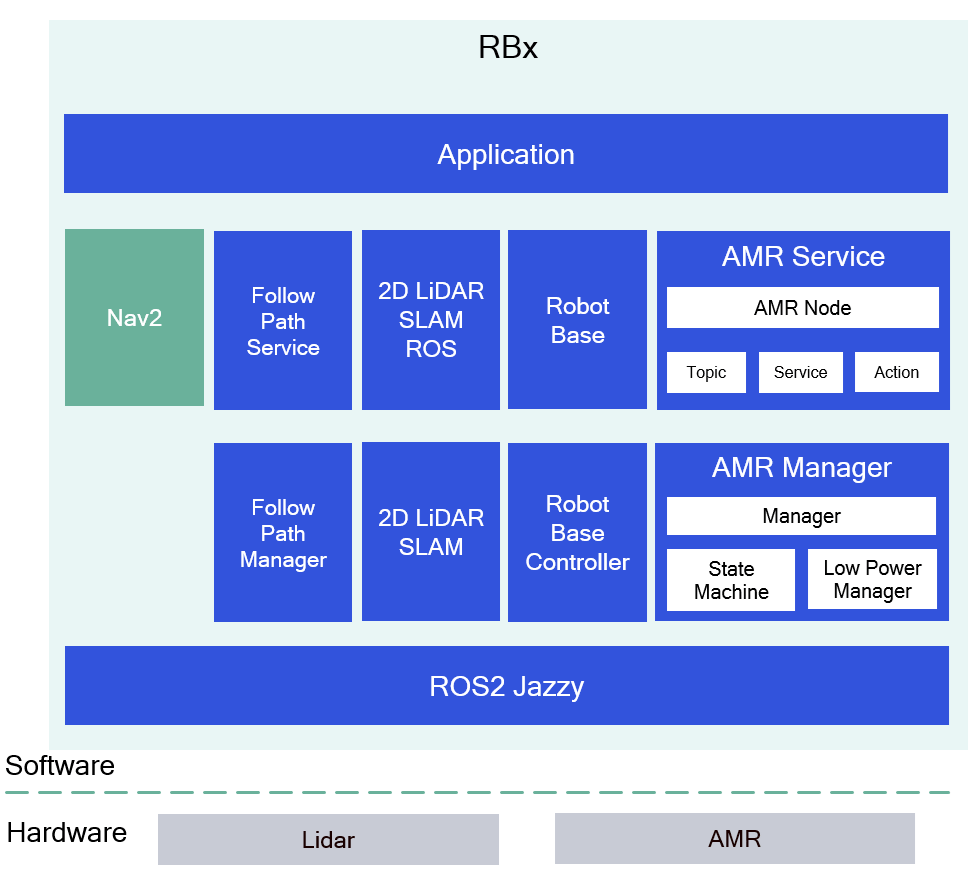
Software structure of the AMR service.
ROS nodes and modules used in the AMR service
The following table lists the ROS nodes and modules used in the AMR service and the function of each one.qrb_ros_amr_service APIs
The following table lists the interfaces that qrb_ros_amr_service exposes, with the name, type, and description of each one.
Prerequisites
You have set up the device, installed ROS2 Jazzy and the Qualcomm Intelligent Robotics (QIR) SDK on the device according to Install the QIR SDK.Run the out-of-the-box AMR service
Run the following commands on the device unless otherwise specified.
1
Install the amr service packages
Install the AMR service packages
2
Set up 2D Lidar SLAM
Run step 1 to step 5 of Run out-of-the-box 2D lidar SLAM to launch 2D Lidar simultaneous localization and mapping (SLAM), skipping step 6.
3
Set up the follow-path service
Set up the follow-path service according to step 1 to step 3 of Run out-of-the-box qrb_ros_follow_path service.
4
Install the nav2 package and set up nav2
Install and launch nav2
5
Set up the sample environment on the device
Launch the AMR service
6
Test the AMR service
-
You can implement a ROS node according to the
qrb_ros_amr_serviceAPIs table to complete the mapping, follow-path and P2P navigation. - You can also use these ROS commands to complete the mapping, follow-path and P2P navigation.
rqt-robot-steering on the host computer (Ubuntu 24.04)rqt-robot-steering on the host computer.rviz2 on the host computer.rqt-robot-steering to control the movement of the robot base.g. Stop mapping.rviz.h. Start a P2P navigation.rqt-robot-steering to move the robot base to waypoint (id = 2).m. Start a follow-path operation from waypoint (id = 2) to waypoint (id = 1).Build from source and run AMR service
Build the autonomous mobile robot (AMR) service from source when you need to change the service code. The device steps install the dependencies, clone the source repositories, build the packages, and run the result.Device steps
1
Install the dependencies
Install the dependencies
2
Download and build
Download and build
3
Run and test
Run and test according to steps 2 to 6 of Run the out-of-the-box AMR service.